TL;DR: A correctly installed manual transfer switch provides defined backup circuits and a straightforward operating routine. An approved panel interlock can offer flexible whole-panel access but requires active load management. The right choice depends on panel compatibility, generator output, neutral/grounding configuration and local electrical approval.
Why transfer equipment matters for a propane generator
A propane generator can provide useful backup electricity, but connecting it to a home’s electrical system requires a safe way to isolate the utility supply. Without approved transfer equipment, electricity could flow backward onto utility lines, endangering workers and damaging equipment. The solution is not a homemade double-ended cord or a breaker that someone promises to remember to switch off.
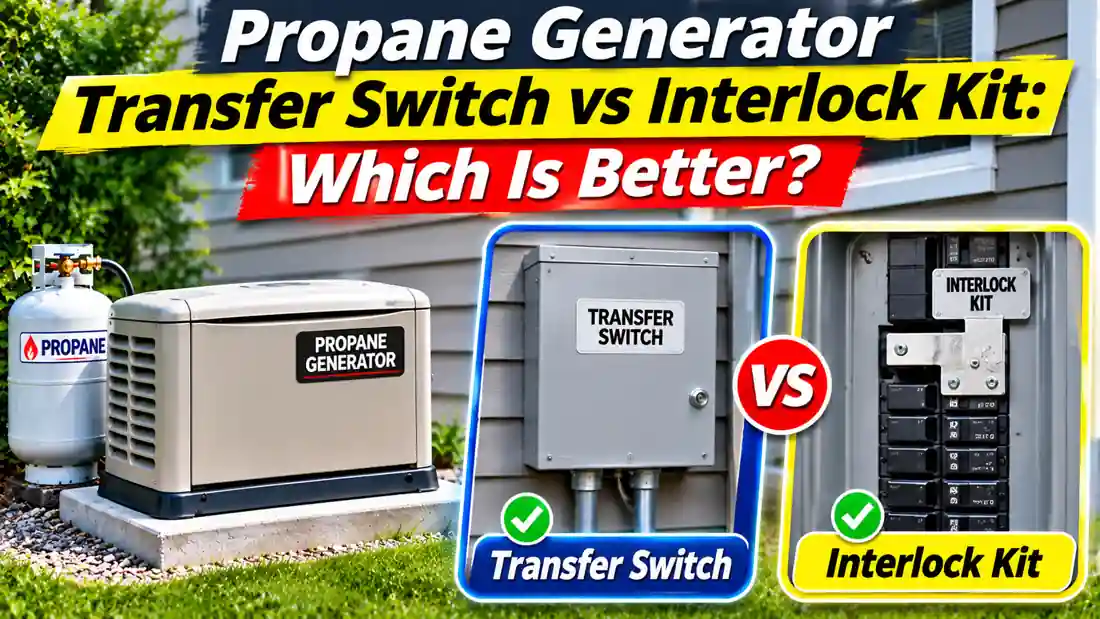
A manual transfer switch and a listed, panel-compatible generator interlock are two approaches used in certain installations. They solve a related problem in different ways. A transfer switch selects the supply feeding specific circuits or an entire panel. An interlock is a mechanical device that prevents the main utility breaker and generator backfeed breaker from being switched on simultaneously.


I would not decide between them based only on the hardware price. The right choice depends on your service panel, generator rating, critical loads, electrical system configuration, local code, permitting and who will operate the backup system during an outage.
What a manual transfer switch does
A manual transfer switch is a purpose-built device that lets an operator transfer selected circuits or a distribution system between utility power and generator power. Many portable-generator kits provide a small panel with dedicated switches for critical circuits, while larger installations may use a service-rated transfer switch to feed a whole panel.
With a critical-circuit transfer switch, you choose in advance which loads can operate on generator power. That can be helpful when the generator is too small for all household circuits. The trade-off is limited flexibility: adding another backed-up circuit later may require an electrician to modify the installation.
The switch must be rated for the voltage, current, number of poles, installation location and source configuration. An electrician also needs to evaluate neutral switching and grounding requirements. A transfer switch is not automatically compatible with every generator just because its ampere rating looks large enough.


What a generator interlock kit does
A generator interlock is a mechanical arrangement installed on a compatible electrical panel so that the utility main breaker and a designated generator breaker cannot be in the ON position together. A correctly designed and installed interlock can prevent simultaneous connection of the two power sources while allowing selected panel circuits to be powered from the generator.
An interlock generally does not select or limit individual loads. Once the panel is supplied by the generator, the operator must switch off nonessential branch circuits and manage demand so the generator is not overloaded. This flexibility is useful to experienced users but requires a clear procedure and accurate understanding of available generator power.
Interlock hardware must be specifically listed or otherwise approved for the exact panel model and breaker configuration, with the correct retaining hardware, labels and inlet installation. A universal-looking metal plate sold online is not evidence of compatibility. The authority having jurisdiction determines whether the installation is acceptable.
The important difference: circuit selection versus whole-panel access
A typical critical-circuit transfer switch gives you a predetermined set of backed-up loads. A typical panel interlock gives generator access to the distribution panel, subject to the operator switching circuits on and off. Neither makes an undersized generator capable of supplying all the loads in the home.
Suppose you own a 7,500-watt running-output generator on propane and your home contains a 4,500-watt electric water heater, 5,000-watt electric range and a central air conditioner. You cannot assume that all these loads will work together merely because an interlock connects the generator to the panel. The operator must prioritize and manage circuits.

I like the discipline of a dedicated critical-loads switch for households that want a simple outage routine. I like the flexibility of a correctly installed interlock when the occupants understand breaker management and the panel and local code support the device. For a generator sizing exercise, see calculating home power needs.
| Feature | Manual transfer switch | Panel interlock |
|---|---|---|
| Circuit access | Often selected circuits | Panel circuits, with manual load control |
| Source isolation | Purpose-built transfer contacts | Mechanical breaker interlock |
| Operator workload | Transfer selected loads | Manage generator breaker and branch loads |
| Panel compatibility | Requires suitable installation | Exact approved panel kit required |
| Automatic operation | No | No |
Electrical ratings you need to understand
Transfer equipment must match the installation’s electrical characteristics. In the United States, many homes have 120/240-volt split-phase service. A 120-volt-only portable generator generally cannot supply ordinary 240-volt household loads through a standard 120/240-volt transfer arrangement. The inlet, wiring, breakers and transfer equipment must be suitable for the actual generator configuration.
The generator’s rated running watts constrain the usable continuous load. A 30-amp, 120/240-volt inlet has a nominal apparent-power capacity of 7,200 VA, calculated as 240 volts times 30 amps. A 50-amp inlet corresponds to 12,000 VA. Those are connection ratings, not promises of generator output. A 5,000-watt generator does not become a 7,200-watt generator because it uses a 30-amp connector.
Continuous-load rules, conductor ampacity, overcurrent protection, voltage drop and equipment listings all matter. An electrician should design the installation using the applicable electrical code and the equipment manufacturer’s instructions rather than selecting a breaker solely from the generator’s peak-watt advertisement.


| Connection rating | Nominal apparent power at 240 V | Important qualification |
|---|---|---|
| 30 A | 7,200 VA | Generator may have lower continuous output |
| 50 A | 12,000 VA | Inlet rating does not increase generator watts |
| 60 A | 14,400 VA | Installation must be engineered for actual load |
Neutral switching and grounding: the technical issue people miss
Some portable generators have a bonded neutral, while others have a floating neutral. The transfer equipment may switch the neutral or leave it solidly connected. The correct arrangement depends on whether the generator is treated as a separately derived system and on the overall grounding and bonding design. This is not a detail to solve by randomly removing a bonding jumper.
A mismatch can cause ground-fault protection to trip, create parallel neutral-ground paths or introduce shock hazards. Generator manuals often state whether the neutral is bonded to the frame and which transfer configurations are permitted. An electrician must evaluate the system, including any ground-fault or arc-fault protection and the applicable code.
I would never recommend a universal neutral-bonding modification to make a generator work with an interlock. Changes to a generator’s internal wiring may violate its listing or instructions. The right solution may involve different transfer equipment or a generator model suitable for the installation.
Manual transfer switch versus automatic transfer switch
An automatic transfer switch (ATS) monitors utility power and, with a compatible standby generator and controller, can start the generator and transfer loads without someone manually operating breakers. This is distinct from a manual transfer switch or interlock. Automatic transfer is valuable when you are away from home, have critical equipment or want seamless routine operation within the system’s designed limits.
An ATS is not automatically the best choice for every portable generator. Many portable units lack the required remote-start, control and transfer interfaces. A standby installation also needs proper fuel supply, exhaust clearance, service disconnecting and load management. Automatic operation should be engineered as a complete system.
If your priority is automatic whole-house backup, compare a professionally installed standby generator and ATS rather than trying to convert a basic interlock into an automatic device. See whether professional propane generator installation is required for the broader installation considerations.
Installation cost: compare the whole project
Hardware-only prices are a poor basis for comparison. A transfer switch may require a separate enclosure, rewiring of selected circuits and additional labeling. An interlock may require a compatible breaker position, generator breaker, approved kit, retaining hardware, inlet box, feeder cable and labels. Both can require permits, inspections and electrical labor.
Actual installed costs vary widely with panel condition, distance to the outdoor inlet, wall construction, conductor sizing, local labor rates and whether the main panel needs replacement. A panel that lacks an approved interlock kit may make the interlock route impractical. An older or overloaded panel may need corrective work before either option can be installed.
I would obtain an itemized quote that separates equipment, labor, permit fees, any panel modifications, inlet and cord, and inspection. Also ask whether the quote includes load calculations and verification of the generator’s neutral configuration. The lowest sticker price is not necessarily the lowest safe installed cost.
| Cost factor | Transfer switch | Interlock |
|---|---|---|
| Hardware | Switch/enclosure and controls | Approved kit and generator breaker |
| Electrical work | Circuit transfers or service wiring | Inlet, feeder, breaker and labels |
| Potential extras | Additional circuits or larger switch | Panel changes if kit incompatible |
| Permits | Often required | Often required |
A sample load-management plan
Imagine an outage in which you want to power a refrigerator, freezer, lighting, router, gas furnace blower and a small well pump. The refrigerator and freezer compressors cycle, and the pump may have a substantial starting surge. I would list normal running demand, starting behavior and priority before energizing circuits.
With a critical-circuit transfer switch, the selected circuits are known in advance. With an interlock, I would first turn off large loads such as the electric range, water heater, dryer and central AC unless the generator is designed to supply them. Then I would start the generator outdoors, transfer according to the approved operating procedure and restore essential circuits in stages.
If central cooling is a priority, read whether a propane generator can run central AC. If several appliances must operate together, my multiple-appliance generator guide explains how to build a realistic load list.
| Illustrative load | Typical planning concern | Priority |
|---|---|---|
| Refrigerator and freezer | Compressor starting surge | High |
| Gas furnace blower | Motor starting and controls | High |
| Router and lighting | Steady, modest draw | High |
| Well pump | High starting surge | Situational |
| Electric water heater | Large resistance load | Usually shed |
| Electric range | High simultaneous demand | Usually shed |
The generator inlet, cord and placement
A permanent outdoor generator inlet is different from a household receptacle. It is designed for the generator’s power to enter the premises through approved wiring and transfer equipment. The inlet configuration must match the generator’s receptacle, voltage and current ratings. Adapters that defeat grounding or allow unsafe backfeeding should not be used.
The generator itself must operate outdoors at the clearances specified by the manufacturer, away from doors, windows, vents and occupied spaces. Carbon monoxide can enter homes even when a generator is outside but placed too close to openings. Never operate a portable generator in a garage, shed, crawlspace or partially enclosed porch.
Plan a safe route for the generator cord so it is protected from water, abrasion, vehicles and foot traffic. Outdoor connections and enclosures need appropriate weather ratings. Do not assume that a weather-resistant inlet makes every extension cord or generator connection safe in rain.
Operating procedure during an outage
The exact operating sequence depends on the installed equipment and should be documented by the electrician. A typical manual system requires you to disconnect or isolate the utility source before connecting the generator supply, then energize circuits gradually while monitoring generator performance. Never improvise an operating sequence based on a different panel shown in an online video.
Before an outage, I would place a concise instruction card near the transfer equipment, identify essential circuits, and ensure responsible household members know where the generator can be safely positioned. Test the system under supervision when first installed. Confirm that carbon monoxide alarms function and that propane supply is adequate.
When utility power returns, follow the installed system’s prescribed retransfer and shutdown sequence. An interlock prevents certain simultaneous breaker positions but does not prevent every possible operating mistake, such as connecting excessive loads or running the generator in an unsafe location.
Common mistakes and how to avoid them
One frequent mistake is assuming that a generator interlock kit is universally compatible with any breaker panel. Another is buying a transfer switch with too few circuits or insufficient rating for the intended loads. A third is overlooking the generator’s neutral configuration and creating an unsuitable bonding arrangement.
People also confuse starting watts with continuous output, overlook the fuel supply required during heavy loading, and place portable generators too close to the home. A correct electrical connection does not make an unsafe exhaust location acceptable. I recommend treating generator installation as a coordinated electrical, fuel and site-safety project.
Do not use a homemade male-to-male cord, backfeed a dryer receptacle, bypass a breaker or modify a panel cover to make an unapproved interlock fit. These shortcuts can defeat the very isolation function the equipment is supposed to provide.
Frequently asked questions
Is an interlock kit as safe as a transfer switch? A correctly approved and installed interlock can provide effective mechanical source isolation, but suitability depends on the exact panel, generator and local code. Neither option is safe when installed improperly.
Can I use an interlock with any electrical panel? No. You need an approved kit for the exact panel and breaker arrangement, and the authority having jurisdiction must accept the installation.
Does an interlock automatically limit generator load? No. The operator must manage branch circuits or use an engineered load-management system.
Can I run 240-volt appliances? Only if the generator and wiring provide the required 120/240-volt supply and have sufficient capacity for the load and starting demand.
Does a transfer switch require an electrician? In most residential applications, electrical installation should be performed by a qualified electrician, and local permit and inspection rules may require it.
Can I use an automatic transfer switch with a portable generator? Only when the generator and controls are explicitly compatible with the ATS arrangement. Do not assume a basic portable unit can be automated.
Which is cheaper? An interlock may cost less in some compatible panels, but labor, inlet installation and panel modifications can change the comparison. Get complete installed quotes.
Do I need to change the neutral bond? Do not make such a change without an electrician evaluating the specific generator and transfer system.
Can I connect my generator through an ordinary outlet? No. Use an approved inlet and transfer equipment; never backfeed through a receptacle.
Which works better for an entire house? A service-rated transfer system or compatible interlock may allow whole-panel access, but the generator still must be sized for the loads you actually use.
Which would I choose?
For a household that wants a straightforward set of essential backup circuits and minimal breaker decisions during a stressful outage, I generally favor a properly sized manual transfer switch. For a household with a compatible panel, an approved interlock and occupants who can manage circuits carefully, an interlock can be a flexible option. For automatic standby backup, I would consider a matched generator and automatic transfer switch installed as a system.
I would ask the electrician to show the exact listing or approval, explain neutral and grounding arrangements, verify the generator’s propane-rated output, and demonstrate the safe operating procedure. The best equipment is the equipment that matches your actual loads and can be operated correctly every time. For fuel planning, see the propane tank size chart.

Mike is an experienced propane technician with over 15 years of professional experience in the field. He has dedicated his career to helping customers with their propane needs, from installation to maintenance and repair. Together with Jeremy, he co-founded this website to provide useful information and guidance to customers seeking reliable propane services.