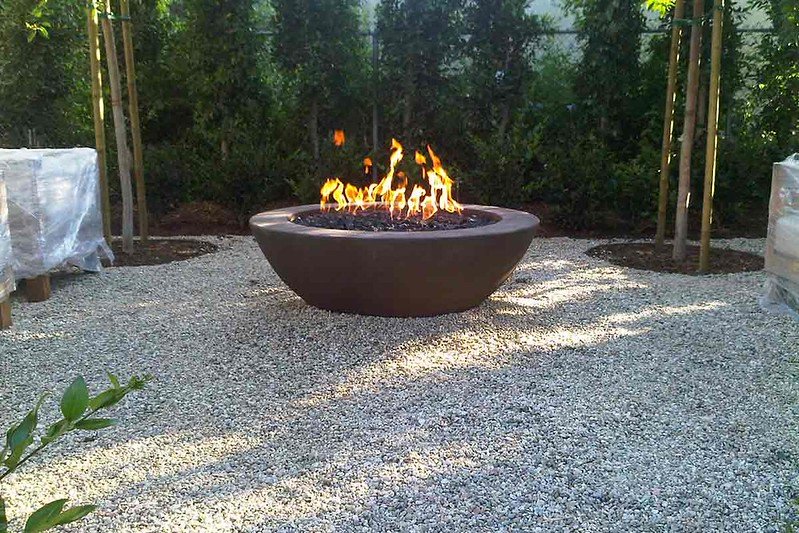
Quick Answer:
To set up a propane fire pit in your backyard, I would start by selecting a manufacturer-approved outdoor location with a stable, level surface and the required clearances from combustible materials. Next, I would read the exact model’s manual, inspect the burner, hose and regulator, secure the correct propane cylinder upright, make only the owner-permitted connections, and perform the specified leak check before lighting. I would use the manufacturer’s ignition sequence, supervise the flame, and shut off both the appliance and cylinder as directed after each use.
Do not assume every fire pit can sit on a wood deck, under a pergola, or inside a screened patio. Clearances, ventilation rules and permitted surfaces differ by model and local regulations. Built-in burners and hard-piped supplies are jobs for a qualified gas installer.
A propane fire pit can change how you use your backyard. Instead of collecting firewood and waiting for embers, you can have an outdoor gathering spot that is easier to start and shut down. But I would not put the fire pit in the first empty corner of the patio and call that a setup. Placement, the gas supply, traffic flow and the weather all affect whether the space will be comfortable and safe.
In this guide, I will walk you through how I would plan a backyard propane fire pit setup, including the equipment choices, safety checks, cylinder considerations, technical figures, fuel consumption and real operating costs. I will also give you a calculator so you can estimate whether a 15 lb exchange cylinder or a full 20 lb refill can cover your next gathering.
If you have not chosen a model, my propane fire pit buying guide explains the major types, features and price considerations. This article focuses on what to do after you decide you want one in your backyard.


1. Plan the Backyard Location Before Buying Accessories
My first priority is the site, not the flame color. A great-looking fire pit becomes frustrating when people have to squeeze between chairs, the cylinder door is blocked, or the burner sits beneath an overhead cover that the instructions prohibit. I would mark out the entire seating area before opening the box.
Choose an open-air, stable location
Look for a firm, level location where the fire pit will not rock when someone approaches it. Pavers, concrete and stone are often practical candidates, but you still need the manufacturer’s instructions for the surface and surrounding installation. Wood or composite decking, rugs and other combustible surfaces require special attention. I would never assume that placing a random paving slab or heat mat underneath an unapproved fire pit makes a combustible deck safe.
A propane fire pit designed for outdoor use belongs outdoors in a sufficiently ventilated area. An enclosed sunroom, garage or indoor living room is not an alternative when it is raining. Covered porches, pergolas, screened rooms and partially enclosed patios need a specific review of the appliance’s listed use, clearance requirements, local building/fire rules and any property restrictions. When approval is uncertain, I would choose an open-sky location or not operate it.
Check clearances from all directions
You will see different clearance numbers on different brands of fire pits. Some manufacturers specify distances from the edge of the burner to side combustibles and an overhead minimum; others prohibit overhead construction or require much greater spacing. I would record the exact side, rear, overhead and surface clearances for my model and measure the actual space. I would not present one universal distance as if it applied to every backyard fire pit.
Watch for less obvious combustibles: the edge of a sofa cushion, a wind-blown curtain, stored pool chemicals, overhanging branches, a fence cap or a pergola shade panel. Keep the fire pit away from routes where children and pets run, and do not create a narrow exit between the hot feature and a wall.



| What I inspect | Pass condition | If it does not pass |
|---|---|---|
| Surface | Stable, level and approved by the appliance manufacturer | Move it or select a suitable rated base or product |
| Side and overhead clearance | Meets the exact model instructions and local requirements | Choose a location with more open space |
| Airflow | Outdoor ventilation is adequate; not an enclosed room | Do not operate in that location |
| Seating and walkways | Guests can pass without brushing the fire pit | Rearrange furniture and paths |
| Cylinder position | Approved upright position with protected, accessible connections | Use an approved placement or enclosure |
| Wind and weather | Conditions are within the manual’s operating limits | Postpone use in unsafe weather |
| Rules and permissions | Fire restrictions, HOA or rental terms allow use | Resolve permission before buying or lighting |
The clearance dimensions must come from your exact fire pit manual. This checklist does not replace those model-specific numbers.
Leave room for people rather than filling every inch with seating
I would design the space as a small outdoor room with at least one clear approach and exit. Before setting chairs down, I would temporarily mark the outline of the fire pit and its required exclusion zone. Then I would add seating outside that zone, leaving walking space for anyone carrying a drink or moving around other guests.
Here is a practical trick: stand where each person will sit and look around at knee height. Do you see a hose, loose gravel, an uneven paver or a chair leg in the path? Fix those problems before worrying about decorative fire glass. The best backyard layout is one people can move around without thinking about the flame every second.
Check local restrictions before the first burn
Rules can differ by city, neighborhood, fire district and property type. Some locations limit outdoor fires during dry or windy periods; others regulate gas appliances on balconies or under roof structures. I would check the relevant local fire authority, building rules and any HOA or lease terms. A propane fire pit does not automatically qualify for an exception to every outdoor-fire restriction.


If you are renting, take a look at my guide to propane fire pits for renters before you buy. Written permission and cylinder storage rules may matter as much as the fire pit itself.
2. Compare Propane Fire Pit Types Before Setting Up Your Backyard
Not every model is installed the same way. A portable bowl that ships with a matching hose and regulator is a very different project from a permanent masonry fire feature. The following input bands are illustrative ranges for comparison, not guaranteed specifications or installation approvals for every product.
| Type | Illustrative LP rating | Typical supply | Setup implications |
|---|---|---|---|
| Portable fire bowl | 30,000–60,000 BTU/h | Approved portable cylinder, often 20 lb | Confirm level surface, hose layout, ventilation and burner media |
| Fire pit table | 35,000–65,000 BTU/h | Often a 20 lb cylinder in a listed compartment | Verify cylinder retention, enclosure ventilation and access door |
| Compact tabletop unit | 8,000–25,000 BTU/h | Model-specific small cylinder or approved supply | Never assume indoor use; verify the allowed fuel and location |
| Built-in decorative burner | 50,000–125,000 BTU/h | Designed propane line, remote cylinder or bulk supply | Qualified professional for gas piping, valves and final testing |
| Large custom fire feature | 100,000–250,000+ BTU/h | Purpose-designed LP system or bulk tank | Engineering, permits, supply capacity and fire-safety review |
Ratings and supplies vary. Use the data plate and installation manual for the exact model; a high BTU rating alone does not prove a portable cylinder can supply enough vapor.
A portable fire table is often a reasonable starting point when you want predictable assembly and the ability to rearrange a patio. A built-in feature can look more integrated with hardscaping, but it introduces permanent fuel-supply decisions, drainage, ventilation requirements and a bigger project budget. I would compare those tradeoffs before committing to a permanent spot.
You can also compare fire pit tables versus bowls if you are deciding whether you want a table for drinks or an unobstructed fire feature.
Which parts should come with a propane fire pit?
The manufacturer’s packing list is the authority. Common components include the burner and control valve, an approved regulator and hose, mounting hardware, a cylinder restraint or enclosure, ignition components, specified decorative media and a cover. Some products ship partly assembled; others require limited owner assembly. I would set all parts on the ground, compare them with the manual, and stop if anything essential is damaged or missing.
I would never substitute a random regulator, stretch a short hose to reach a tank, replace an orifice to get a bigger flame, or bury a hose under paving. The components in a listed appliance are designed as a system. If the fire pit needs permanent piping or other gas-train changes, I would use a qualified professional.
3. How I Would Set Up a Propane Fire Pit in the Backyard: Step by Step
This is my practical owner-level preparation checklist for a portable unit. The exact assembly and lighting instructions must come from the appliance manufacturer. For built-in or hard-piped installations, use the specified professional installation process instead of applying a portable-fire-table checklist to a permanent system.
Step 1: Unpack, inspect and identify the fire pit
I would read the manual before removing safety labels. Check the model number, LP fuel marking, input rating, hose and regulator assembly, igniter, controls and burner media. Look for damaged threads, bent metal, cracks in the hose or anything that appears to have shifted in transit. I would also check for relevant recalls or manufacturer service notices before the first use.
Do not use a unit with damaged gas components, and do not attempt to fix a leaking control valve yourself. A professional should inspect any questionable assembly.
Step 2: Set the base on the selected surface
Follow the supplied assembly instructions and tighten ordinary frame hardware to the specified requirements without changing the gas fittings. The finished fire pit should sit level and resist tipping or rocking. Confirm the control panel, cylinder compartment door and shutoff are accessible without reaching into a hot flame area.
Before loading the burner with decorative media, check whether the unit needs drainage openings or airflow passages to remain unobstructed. A fire pit that collects water or traps gas because its vents are blocked will not become safer just because it looks finished.
Step 3: Prepare the correct propane cylinder
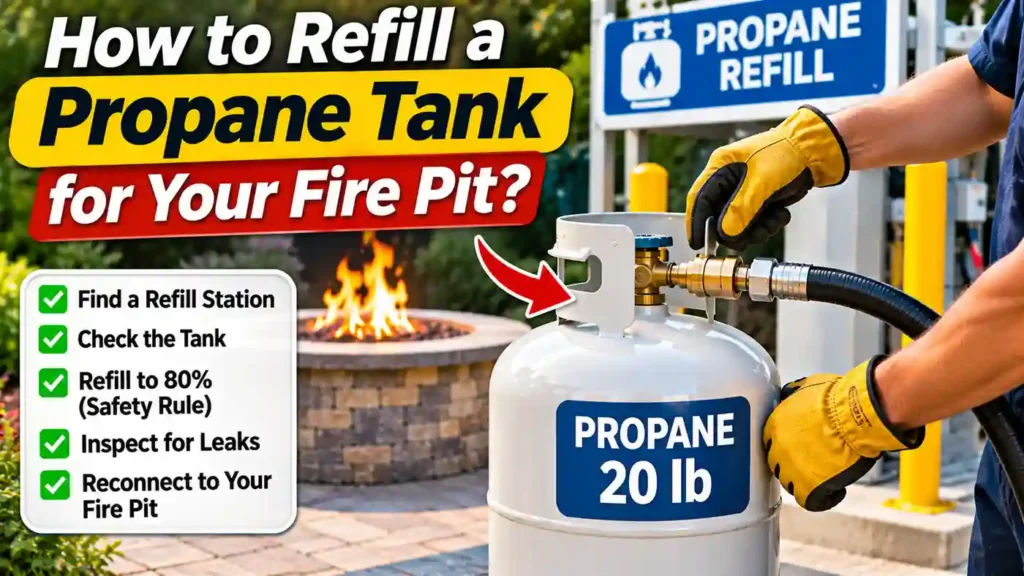
Read the fire pit’s fuel-cylinder specifications. A common residential fire table is designed around a 20 lb vertical LP cylinder, but I would not assume all portable bowls, tables or built-in units use the same arrangement. Verify the cylinder is suitable, in good condition, within applicable qualification dates and filled by an approved supplier.
Keep the cylinder upright in its intended operating position and in a location approved by the appliance manufacturer. Do not put it in a sealed box, bury it or hide it in a way that traps propane vapor. If your fire table has an integrated cylinder compartment, use the supplied restraint and keep the designed upper and lower ventilation paths open.
Step 4: Make only the permitted gas connection
With the appliance off and away from ignition sources, follow the exact cylinder-connection instructions supplied with the product. I would check that the specified hose and regulator are undamaged and not routed near the burner, hot underside or sharp metal edges. Connections should not be forced or modified, and the regulator must match the appliance.
Some quick-connect or cylinder fittings seal differently from pipe-thread fittings. Do not apply thread tape or sealant where the manufacturer has not specified it. If the assembly does not connect exactly as described, stop and ask the manufacturer or a qualified gas installer.
Step 5: Perform the specified leak check before lighting
This is not a step I would skip to save five minutes. Follow the manufacturer’s instructions for a suitable leak-detection solution and the permitted test points. Never search for leaks with a flame. If the solution produces persistent bubbles, if you hear escaping gas or if you smell gas, do not light the unit. Shut it down only if safe to do so, move away from the area, and obtain qualified help.
For a suspected substantial leak, leave the area and contact the propane supplier or emergency responders from a safe location. Do not flip electrical switches, use ignition sources or keep troubleshooting inside a gas-filled enclosure.
Step 6: Add only approved fire glass or lava rock
Use the decorative media type, amount and arrangement specified for the burner. Avoid ordinary river rocks, unknown landscaping stone or random glass that was not made and approved for the appliance; unsuitable materials can damage the burner or fracture when heated. Do not pile media over ignition ports, pilot openings, sensors or required airflow passages unless the manual explicitly directs that placement.
My guide to decorative elements for propane fire pits covers the visual choices. For setup, the most important thing is that the decoration must not interfere with the equipment.
Step 7: Light the fire pit exactly as instructed
Once the location, fuel supply, connections and inspection requirements all pass, use the manufacturer’s lighting procedure. Stay clear of the burner while lighting, follow any stated waiting period after an unsuccessful ignition attempt, and never bypass a flame-safety device. If ignition fails repeatedly, stop and troubleshoot only through the manual’s safe homeowner checks or professional service.
Watch the first operating period carefully. The flame should be consistent with the manufacturer’s description, without abnormal soot, lifting, delayed ignition or uncontrolled height. If something appears wrong, shut the unit down and arrange inspection.
Step 8: Arrange the seating and finish the backyard
After the equipment is confirmed safe, I would place chairs outside the required clearance area, keep loose pillows and blankets away from the flame, and leave enough room for people to circulate. Put drinks on a separate side table unless the fire table manufacturer specifically identifies a suitable cool surface for them.
Make sure everyone knows where the shutoff is and who is supervising the fire. I would keep children and pets away from the hot unit even after the flame is out because metal and glass surfaces can stay hot.
Step 9: Shut down and cover the fire pit correctly
Use the shutdown order in the manufacturer’s instructions, including turning off the gas supply valve as directed. Never cover the burner while it is hot. Wait for the appliance and media to cool before installing a compatible cover, and protect the unit from rain without blocking required ventilation or creating an unapproved storage situation.
4. What Are the Common Setup Mistakes I Would Avoid?
Most problems start with assumptions: assuming the patio is big enough, assuming the tank fits, or assuming the burner is ready merely because it can be lit. This is where I think a simple checklist is more valuable than buying extra accessories.
| Common mistake | Why it matters | Better next step |
|---|---|---|
| Placing under an unapproved roof or awning | Overhead heat, trapped exhaust or combustible-material exposure | Choose a permitted open-air location |
| Using the wrong hose or regulator | Incorrect pressure or overheating risk | Use only the specified compatible assembly |
| Hiding the cylinder in a sealed chest | A leak may collect in the enclosure | Use only a ventilated, approved cylinder arrangement |
| Skipping the first-use leak check | A loose or damaged connection may go unnoticed | Follow the manual before ignition |
| Using landscape rocks in the burner | Material may crack or obstruct flame and ignition | Use the specified fire media and placement |
| Letting guests walk directly past the burner | Increased contact and trip hazards | Keep a clear route around the seating area |
| Assuming a 20 lb exchange holds 20 lb of fuel | Runtime and budget may be overstated | Read the actual net fill on the exchange label |
One mistake that is easy to miss is thinking of the cylinder only as fuel storage. It also has to vaporize liquid propane quickly enough to feed the burner. Cold weather, a nearly empty cylinder and a high-output fire pit can all reduce available vapor flow. If the flame shrinks on a chilly evening, I would not increase regulator pressure or enlarge an orifice. I would have the fuel supply and burner requirements checked instead.
5. How Much Propane Does a Backyard Fire Pit Use?
Now to the fuel math. This is the part I like to calculate before I decide how often to use the fire pit. Propane contains approximately 91,500 BTU per US gallon, and a nominal full 20 lb cylinder holds about 4.7 US gallons of propane. Actual fill quantities and real operating conditions vary.
The heat input printed on the fire pit is normally in BTU per hour. At full rated input, the division is straightforward. For a portable cylinder, the theoretical runtime is the amount of usable propane energy divided by the burner’s hourly draw.
These are fuel-energy estimates, not a guarantee that a cylinder can provide the necessary vapor withdrawal rate. They also assume operation at the input figure entered. Turning the knob to a halfway position does not necessarily mean precisely half the fuel flow.
| Rated LP input | Gallons/hour | Full 20 lb cylinder | 15 lb exchange fill | Fuel for 3 hours |
|---|---|---|---|---|
| 20,000 BTU/h | 0.22 gal | 21.5 h | 16.1 h | 0.66 gal |
| 30,000 BTU/h | 0.33 gal | 14.3 h | 10.8 h | 0.98 gal |
| 40,000 BTU/h | 0.44 gal | 10.8 h | 8.1 h | 1.31 gal |
| 50,000 BTU/h | 0.55 gal | 8.6 h | 6.5 h | 1.64 gal |
| 60,000 BTU/h | 0.66 gal | 7.2 h | 5.4 h | 1.97 gal |
| 75,000 BTU/h | 0.82 gal | 5.7 h | 4.3 h | 2.46 gal |
| 100,000 BTU/h | 1.09 gal | 4.3 h | 3.2 h | 3.28 gal |
20 lb values assume approximately 4.7 gallons; 15 lb values assume approximately 3.525 gallons. These are theoretical runtimes, not assured continuous cylinder output.
What does that mean for a normal backyard evening?
Suppose you choose a 50,000 BTU/h fire table and run it for three hours on its rated full-input setting. The estimated fuel use is 50,000 ÷ 91,500 = 0.546 gallon per hour. Over three hours, that becomes 1.64 gallons. If you paid $4 per gallon for a refill, the evening uses approximately $6.56 worth of propane.
A full 20 lb cylinder would provide about 8.6 theoretical hours at that rate; a cylinder exchanged with only 15 lb of fuel would have about 6.5 theoretical hours. That difference is why I would read the fill quantity rather than relying on the cylinder’s familiar “20 lb” size designation.
For a deeper tank comparison, see how long a 20 lb tank lasts on a fire pit. If you are deciding what to buy, I have a separate fire pit tank sizing guide.
6. How Much Does a Propane Fire Pit Cost to Run?
The burner’s rating and your local fuel cost drive the hourly expense. To make this easy to compare, I calculated three scenarios using $3, $4 and $5 per US gallon. These are planning prices, not a claim about what your local station charges today.
| Burner rating | Gallons/hour | At $3/gal | At $4/gal | At $5/gal |
|---|---|---|---|---|
| 20,000 BTU/h | 0.219 | $0.66 | $0.87 | $1.09 |
| 30,000 BTU/h | 0.328 | $0.98 | $1.31 | $1.64 |
| 40,000 BTU/h | 0.437 | $1.31 | $1.75 | $2.19 |
| 50,000 BTU/h | 0.546 | $1.64 | $2.19 | $2.73 |
| 60,000 BTU/h | 0.656 | $1.97 | $2.62 | $3.28 |
| 75,000 BTU/h | 0.820 | $2.46 | $3.28 | $4.10 |
| 100,000 BTU/h | 1.093 | $3.28 | $4.37 | $5.46 |
Figures are rounded. Exchange cylinder pricing may be higher per actual gallon delivered than a refill.
Here is my recommendation: use the cost table to size your budget before choosing a fire pit solely because of its highest BTU number. A high-output burner can be ideal for a large open entertaining area, but a smaller properly rated model may be more economical for a few chairs on a mild evening. More BTUs do not automatically mean that everyone feels proportionately warmer outdoors.
Worked example: two backyard gatherings per week
Say I am planning two gatherings each week, two hours per gathering, using a 50,000 BTU/h fire table at full input. I would budget from the pattern rather than estimate with “one tank per month.” An average month has approximately 4.33 weeks, so the total is 2 gatherings × 2 hours × 4.33 weeks = 17.32 hours a month.
At 0.546 gallon per hour, that is approximately 9.46 gallons per month. At $4 per gallon, the month costs about $37.86 in propane. Two completely full 20 lb cylinders contain approximately 9.4 gallons, so this pattern uses just over two full-cylinder fuel quantities. I would keep some practical margin because real fills, residual fuel and operating conditions differ.
| Backyard use pattern | Hours/month | Gallons/month | Estimated cost/month |
|---|---|---|---|
| One 2-hour evening weekly | 8.66 | 4.73 | $18.93 |
| Two 2-hour evenings weekly | 17.32 | 9.46 | $37.86 |
| One 3-hour event weekly | 12.99 | 7.10 | $28.39 |
| Three 2-hour evenings weekly | 25.98 | 14.20 | $56.79 |
Uses 4.33 weeks per month. Estimated at full burner input; actual consumption depends on the appliance and operating setting.
When people tell me a propane fire pit is “expensive to run,” I want to know their hourly use and actual refill cost before agreeing. A quiet two-hour weekend may cost much less than running a large burner every night. You can compare more scenarios in my hourly and monthly fire pit cost guide.
7. Interactive Propane Fire Pit Runtime and Cost Calculator
Enter your fire pit’s rated propane input, how much fuel is actually in the cylinder, your fuel cost and your planned usage. I built this estimator around the same assumptions as the tables, so the numbers are easy to check. It is for fuel planning, not to determine regulator pressure, gas-line sizing or burner modifications.
At 50,000 BTU/h, fuel use is about 0.55 gal/h and a full 20 lb cylinder yields 8.6 theoretical hours. Your 90% planning estimate is 7.7 hours. Fuel cost is about $2.19/hour.
A planning allowance is only a personal budgeting buffer, not a propane cylinder filling rule. Real delivered vapor capacity, cylinder fills, temperature and flame setting can change practical operation.
If your WordPress editor or security settings remove inline scripts, the tables above still provide the same calculations. The calculator is a convenience; it does not replace the appliance data plate or an installer’s supply-capacity assessment.
8. What Size Propane Tank Is Best for a Backyard Fire Pit?
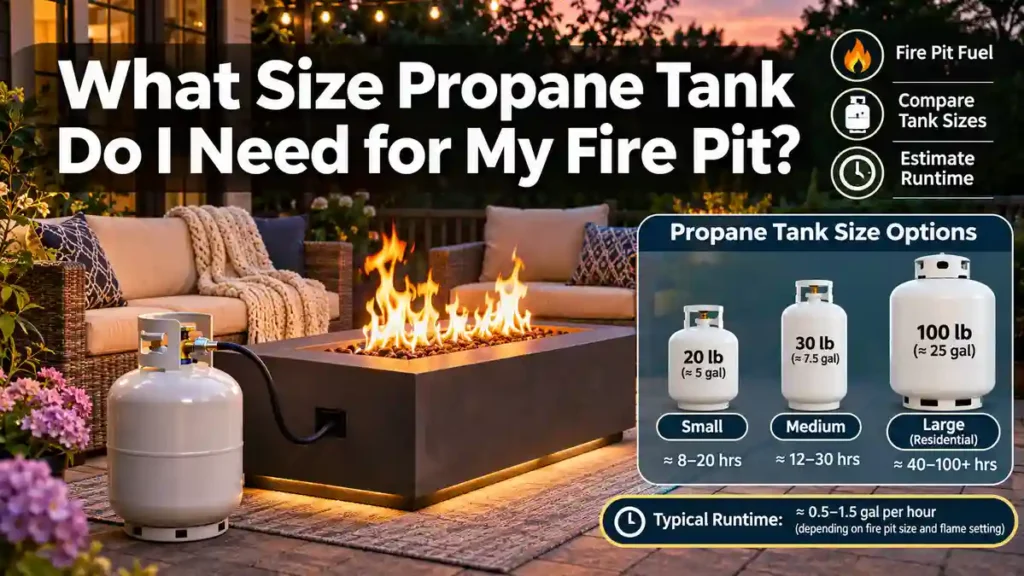
I would select a cylinder only after reading the manual. Many portable units are specifically designed for a 20 lb vertical cylinder. Smaller cylinders save space but reduce runtime, while larger cylinders may be prohibited by the product design or may need a different approved supply arrangement.
Also remember that propane is commonly sold by pounds in portable cylinders and by gallons at refill stations. A 20 lb cylinder refers to its nominal propane capacity, not the combined weight of tank and fuel. A “20 lb” exchange program may actually provide a 15 lb net fill, which changes the run-time calculation without changing the steel cylinder’s outside dimensions.
| Propane content | Approx. US gallons | At 40,000 BTU/h | At 50,000 BTU/h | Fuel value at $4/gal |
|---|---|---|---|---|
| 10 lb | 2.36 gal | 5.4 h | 4.3 h | $9.43 |
| 15 lb | 3.54 gal | 8.1 h | 6.5 h | $14.15 |
| 20 lb | 4.72 gal | 10.8 h | 8.6 h | $18.87 |
| 30 lb | 7.08 gal | 16.2 h | 12.9 h | $28.30 |
| 40 lb | 9.43 gal | 21.6 h | 17.3 h | $37.74 |
Cylinder compatibility is model-specific. A large or cold-weather burner may exceed the cylinder’s vapor delivery capacity even with fuel remaining.
If I expect to entertain several evenings each week, I would compare how frequently I must visit a refill station, whether a spare cylinder is permitted and whether the fire pit is actually approved to use the supply I want. Keeping two cylinders does not mean they may be connected together with an improvised tee or unapproved manifold.
On the other hand, if I use a small fire pit for short occasional gatherings, paying for a large permanent propane system may make little sense. For the smallest usable options, read the smallest propane tank you can use for a fire pit.
9. My Maintenance and Pre-Use Checklist
The first setup is only part of ownership. Before each gathering, I would take a short look at the equipment and surroundings. The goal is to find a problem while the system is cold instead of during a party with the burner already running.
- Fuel and labels: Correct fuel type, cylinder in good condition and the actual fill amount understood.
- Hose and regulator: No cracks, abrasion, loose fittings or contact with a hot surface.
- Enclosure: No blocked vents, pooled water, leaves or combustible storage next to the cylinder.
- Burner media: Correct placement without covered ignition ports or sensors.
- Location: Required clearances remain open despite new furniture, plants or decor.
- Weather and rules: Appropriate wind, fire restrictions and local permission for that day.
- Supervision: Someone is responsible for watching the fire and handling shutdown.
Follow the manufacturer’s schedule for cleaning and professional servicing. I would never try to compensate for a weak flame by modifying the gas orifice or regulator. If you suspect a pressure problem, my propane fire pit gas pressure guide explains what specifications matter and why measurement belongs to qualified work.
For ongoing costs and whether an older unit is still worth maintaining, see how long propane fire pits last.
10. Backyard Propane Fire Pit Setup Decision Guide
When I compare backyard designs, I would rather make one good decision upfront than redo the patio later. This is how I would match the project to the outdoor space and level of commitment.
| Your backyard situation | My preference | What to confirm first |
|---|---|---|
| Small, open patio; occasional use | Portable LP fire table or bowl | Manual clearances, walking space and correct cylinder |
| You want to move furniture seasonally | Freestanding, manufacturer-assembled model | Stable approved surface and storage plan |
| Permanent stone patio renovation | Built-in listed burner system | Qualified installation, gas piping, permits and drainage |
| Deck or covered pergola | Only a product/location specifically permitted | Combustible surface, ventilation and overhead clearance requirements |
| No safe outdoor cylinder location | Postpone propane purchase | Resolve storage, supply and local restrictions first |
| Large decorative feature with high BTU demand | Professionally designed LP supply | Tank vaporization, regulator and line sizing |
My general preference for a first backyard setup is a well-supported, manufacturer-complete fire table with an appropriate cylinder compartment, provided the site meets every clearance and ventilation requirement. That keeps the project manageable and leaves fewer opportunities to mix incompatible gas parts. A permanent built-in system makes sense when you already know exactly how the patio will be used and you are prepared for a professional installation.
Frequently Asked Questions About Backyard Propane Fire Pit Setup
Can I set a propane fire pit on my lawn?
Only if the appliance manual permits the ground surface and the fire pit remains stable and level. Grass and landscaping may present combustible or tipping hazards. I would not place an ordinary fire table directly on uneven ground and assume its legs will stay stable.
Can a propane fire pit go on a wood or composite deck?
It depends on the appliance listing, specified clearances, local rules and any approved protective components. Do not assume an aftermarket mat or paver makes an otherwise prohibited installation safe.
How far should a propane fire pit be from my house?
Use the side, rear, overhead and surface clearances in the exact fire pit manual and any stricter local rules. Different fire pits have different construction and certification requirements; there is no safe universal distance for every product.
Can I place a propane fire pit under a pergola?
Only when both the manufacturer and local requirements explicitly permit that specific covered arrangement, with the required ventilation and overhead clearance. If the cover is combustible or the space traps exhaust, I would choose another location.
Do I need a professional to install a propane fire pit?
A complete portable fire table may allow limited owner assembly and connection under its instructions. Hard piping, built-in fire features, fuel conversions, unfamiliar regulators or anything requiring gas-line work should be handled by a qualified gas professional and relevant permits or inspections.
How much propane does a 50,000 BTU fire pit use in two hours?
At full input, about 1.09 gallons: 50,000 ÷ 91,500 × 2. At $4 per gallon, the theoretical fuel expense is about $4.37. Real consumption varies if the burner operates at a lower input rate.
How long will a 20 lb propane tank last on a fire pit?
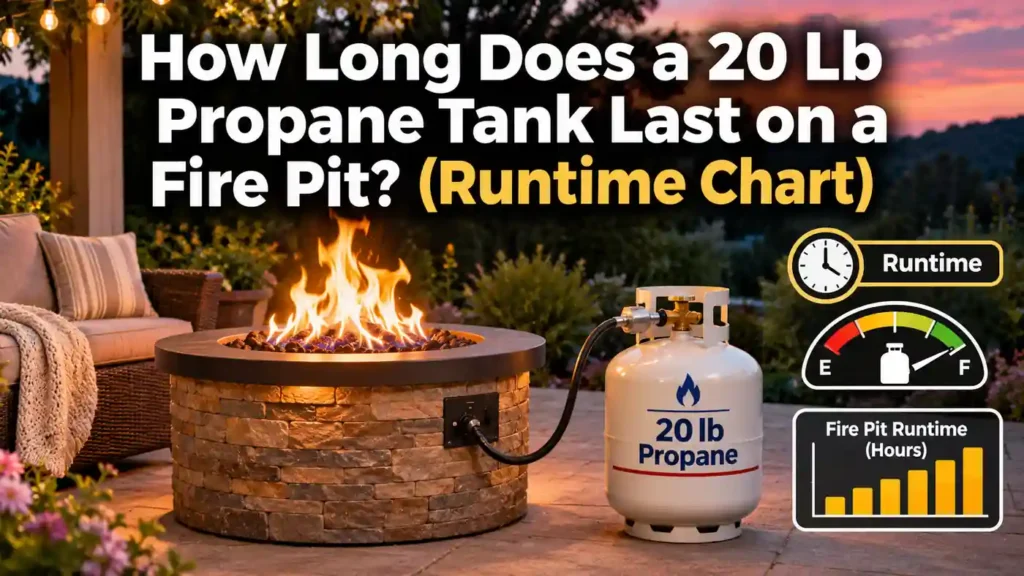
For a full 20 lb fill containing approximately 4.7 gallons, theoretical runtime is about 10.8 hours at 40,000 BTU/h and 8.6 hours at 50,000 BTU/h. Real-world runtime can be shorter due to cylinder delivery capacity, weather and fuel remaining.
Should I turn off the propane cylinder after each use?
Follow your appliance’s specified shutdown procedure, which generally includes shutting off the supply at the cylinder as directed. Let the burner cool before covering, cleaning or storing equipment.
Can I use a backyard propane fire pit for roasting marshmallows?
Only if the manufacturer allows food preparation over that specific fire pit. Many decorative gas fire features are not designed for cooking. I cover the distinctions in my guide to roasting marshmallows over propane fire pits.
Final Thoughts: Build a Backyard Gathering Spot That Is Easy to Use Safely
I would judge a successful backyard propane fire pit setup by what happens after the first night: is the space comfortable, can everyone move around safely, is the cylinder accessible, and can you light and shut down the feature exactly as intended? If those basics are right, the decorative details become much more enjoyable.
Start with a permitted open-air location, a properly rated appliance, its original approved components and the manufacturer’s instructions. Use a qualified installer for permanent gas work, verify the connections and clearances, and plan the fuel budget using real BTU figures rather than guesses.
My next suggested read is the complete propane fire pit buying guide if you are still comparing models, or the propane fire pit operating cost guide if you want to fine-tune a monthly backyard budget. A fire pit should make your outdoor space simpler to enjoy—not more complicated to manage.

Mike is an experienced propane technician with over 15 years of professional experience in the field. He has dedicated his career to helping customers with their propane needs, from installation to maintenance and repair. Together with Jeremy, he co-founded this website to provide useful information and guidance to customers seeking reliable propane services.