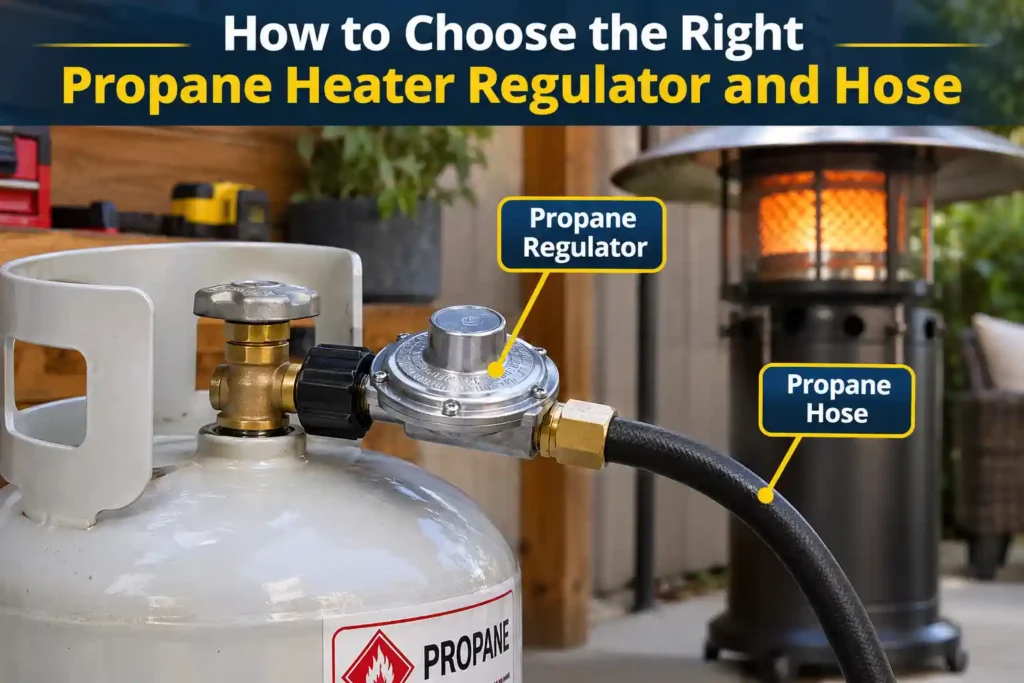


Choosing the right propane heater regulator and hose is essential for maintaining a reliable and safe fuel supply. Although these components may appear simple, selecting the wrong pressure rating, hose length, connection type, or flow capacity can significantly affect your heater’s performance.
A regulator that delivers insufficient propane may cause weak flames, difficulty igniting the burner, and unexpected shutdowns. An incompatible hose may introduce restrictions, connection problems, or potential gas leakage.
Whether you own a portable propane heater, patio heater, garage heater, or residential wall heater, understanding the requirements of your equipment can help you avoid purchasing incompatible replacement parts.


I recommend looking beyond product descriptions that claim universal compatibility. Propane heaters have different operating requirements, and a regulator that works perfectly with one appliance may be unsuitable for another.
In this guide, I’ll explain how to choose the right propane heater regulator and hose, understand pressure and capacity ratings, identify compatible fittings, and avoid common purchasing mistakes.
Quick Answer
To choose the right propane heater regulator and hose, check the following seven specifications:
- Outlet pressure: Match the heater manufacturer’s specified gas supply pressure.
- BTU capacity: Ensure the regulator can satisfy the heater’s maximum fuel demand.
- Inlet pressure: Confirm compatibility with the propane supply.
- Connection type: Match the approved cylinder and heater connections.
- Hose length: Choose the manufacturer-approved length.
- Hose pressure rating: Ensure suitability for its position in the fuel supply system.
- Manufacturer approval: Purchase an assembly approved for your particular heater.
Many conventional low-pressure propane heaters require approximately 11 inches of water column (0.4 PSI). However, certain construction heaters require considerably higher pressures, while some portable heaters have built-in regulators.


Never purchase a regulator and hose assembly based solely on its appearance, price, or connection size.
Understanding the Role of the Regulator and Hose
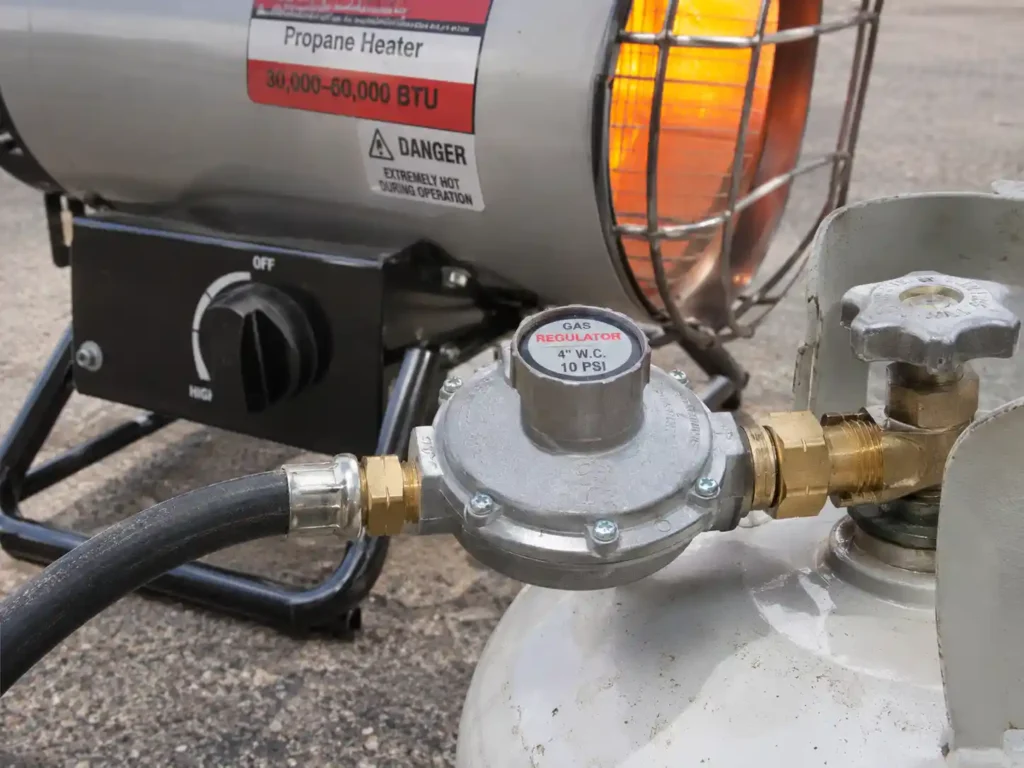
The regulator and hose work together to deliver propane from the cylinder or storage tank to the heating appliance.
Although they are often sold as a complete assembly, each component performs a different function.
| Component | Primary Function |
|---|---|
| Propane regulator | Reduces and controls gas pressure. |
| Propane hose | Transfers propane between components. |
| Cylinder connector | Connects the fuel supply to the assembly. |
| Heater connector | Connects the assembly to the appliance. |
| Regulator diaphragm | Responds to changes in gas pressure. |
| Excess-flow device, if equipped | Restricts flow under certain abnormal conditions. |
| Fuel filter, if required | Helps prevent contamination from entering the heater. |
| Seals and gaskets | Help prevent leakage at designated connections. |
The regulator must maintain the appropriate pressure as fuel demand changes, while the hose must safely accommodate the pressure and flow of propane passing through it.
A high-quality regulator cannot compensate for an incompatible or undersized hose. Similarly, installing a larger hose will not correct an incorrect regulator pressure.



1. Identify Your Propane Heater Type
The first step in choosing a regulator and hose is identifying the type of heater you own.
Different heaters require different fuel delivery configurations.
| Heater Type | Typical BTU Input | Common Regulator and Hose Configuration |
|---|---|---|
| Portable camping heater | 4,000–9,000 | Integrated regulator and approved hose, where applicable. |
| Portable radiant heater | 9,000–18,000 | Model-specific hose assembly. |
| Tabletop patio heater | 10,000–15,000 | Dedicated regulator or cylinder connection. |
| Propane wall heater | 10,000–30,000 | Professionally regulated gas supply. |
| Freestanding patio heater | 30,000–50,000 | External regulator and hose assembly. |
| Garage heater | 30,000–125,000 | Model-specific regulated supply. |
| Forced-air construction heater | 35,000–200,000+ | Dedicated pressure regulator and hose. |
| Tank-top heater | 10,000–45,000 | Manufacturer-specific regulator. |
| Commercial heater | 100,000–300,000+ | Professionally sized fuel delivery system. |
These ranges are illustrative rather than universal equipment specifications.
Start by locating the manufacturer’s identification label. Record the model number, serial number, fuel type, BTU input rating, and gas pressure requirements.


This information will make it considerably easier to identify the correct replacement assembly.
2. Choose the Correct Regulator Outlet Pressure
One of the most important specifications is the regulator’s outlet pressure.
Propane cylinder pressure is generally much higher than the operating pressure required by conventional low-pressure heaters.
The regulator reduces this pressure to a level appropriate for the appliance.
Low-Pressure Propane Regulators
Many residential wall heaters and conventional patio heaters use low-pressure propane supplied at approximately 11 inches of water column.
These regulators are suitable only for appliances specifically designed for that pressure.
High-Pressure Propane Regulators
Certain construction heaters, specialized outdoor appliances, and industrial heating equipment require higher operating pressures.
These heaters may use dedicated fixed-pressure or adjustable regulator assemblies.
A high-pressure regulator should never be substituted for a low-pressure regulator simply to increase heat output.
Propane Regulator Pressure Comparison Chart
| Pressure Rating | Equivalent PSI | Equivalent Inches WC |
|---|---|---|
| 10 inches WC | 0.361 | 10 |
| 11 inches WC | 0.397 | 11 |
| 14 inches WC | 0.506 | 14 |
| 1 PSI | 1 | 27.7 |
| 2 PSI | 2 | 55.4 |
| 5 PSI | 5 | 138.4 |
| 10 PSI | 10 | 276.8 |
| 20 PSI | 20 | 553.6 |
These figures are pressure conversions, not recommended operating pressures for particular heaters.
For example, certain Patio Comfort patio heater models use regulators preset to 11 inches of water column. Other heaters may have entirely different pressure requirements. Always consult the manual for your exact heater model.
Never confuse inches of water column with PSI. A regulator rated at 11 PSI delivers approximately 27.7 times the pressure of a regulator rated at 11 inches of water column.
Installing an incorrectly rated regulator can result in dangerous overpressure, improper combustion, and equipment damage.
You can learn more about this subject in my guide on inlet pressure vs. outlet pressure on a propane regulator.
3. Match the Regulator’s BTU Capacity to the Heater
The regulator must deliver enough propane to satisfy the heater’s maximum rated fuel input.
BTU stands for British Thermal Unit. A heater rated at 40,000 BTU per hour requires a fuel delivery system capable of supporting that maximum input.
If the regulator cannot provide sufficient fuel while maintaining the specified outlet pressure, the heater may struggle to operate at full capacity.
Propane Heater Regulator Sizing Chart
| Heater Input Rating | Minimum Fuel Delivery Demand | Approximate Consumption |
|---|---|---|
| 9,000 BTU/hr | 9,000 BTU/hr | 0.098 gal/hr |
| 18,000 BTU/hr | 18,000 BTU/hr | 0.197 gal/hr |
| 30,000 BTU/hr | 30,000 BTU/hr | 0.328 gal/hr |
| 40,000 BTU/hr | 40,000 BTU/hr | 0.437 gal/hr |
| 48,000 BTU/hr | 48,000 BTU/hr | 0.525 gal/hr |
| 60,000 BTU/hr | 60,000 BTU/hr | 0.656 gal/hr |
| 80,000 BTU/hr | 80,000 BTU/hr | 0.874 gal/hr |
| 100,000 BTU/hr | 100,000 BTU/hr | 1.093 gal/hr |
| 150,000 BTU/hr | 150,000 BTU/hr | 1.639 gal/hr |
| 200,000 BTU/hr | 200,000 BTU/hr | 2.186 gal/hr |
The regulator’s advertised capacity must be evaluated against its actual performance under expected inlet pressure, outlet pressure, and operating conditions.
For additional information, read my guide on what BTU capacity means on a propane regulator.
4. Understand the Difference Between High-Pressure and Low-Pressure Hoses
Not all propane hoses are designed to withstand the same pressure.
The required hose pressure rating depends partly on whether the hose is positioned before or after the regulator.
Configuration A: Regulator at the Cylinder
The hose downstream of the regulator carries propane at the regulated delivery pressure.
Configuration B: Integrated Heater Regulator
Some manufacturer-approved remote-cylinder connections carry cylinder pressure to the heater’s built-in regulator.
These diagrams explain general concepts and are not installation instructions. Never change your heater’s approved fuel delivery configuration.
| Feature | Low-Pressure Hose | High-Pressure Hose |
|---|---|---|
| Typical position | Downstream of low-pressure regulator | Upstream of regulator or approved high-pressure application |
| Gas pressure | Regulated low pressure | Higher pressure, potentially full cylinder pressure |
| Common application | Patio heater assemblies | Approved remote-cylinder connections |
| Construction | Application-specific | Designed for higher working pressure |
| Interchangeable | No | No |
Always check the hose’s rated working pressure and intended application. Burst-pressure ratings are not the same as allowable working pressure.
5. Select the Correct Hose Length
Propane heater hoses are available in various lengths to accommodate different equipment configurations.
The correct length depends on the manufacturer’s requirements, heater design, propane cylinder location, and approved hose routing.
| Hose Length | Common Application |
|---|---|
| 1–2 feet | Compact regulator assemblies. |
| 3 feet | Certain patio heaters. |
| 4–5 feet | Approved portable equipment. |
| 6 feet | Selected outdoor heater applications. |
| 10 feet | Approved remote-cylinder connections. |
| 12 feet | Certain model-specific portable heaters. |
| 15–20 feet | Specialized approved configurations. |
These are examples of commercially available hose lengths rather than recommendations for every heater.
A hose that is too short may place unnecessary strain on connections. An excessively long hose may create routing problems, tripping hazards, or additional pressure loss.
Does a Longer Propane Hose Reduce Gas Pressure?
Yes, pressure loss can increase with hose length, especially when the heater requires a high fuel flow rate.
Other factors include the hose’s internal diameter, gas pressure, fitting restrictions, and number of connections.
For higher-output heaters, hose length and diameter become particularly important.
I recommend using the original manufacturer-specified hose length instead of adding extensions or connecting several hoses together.
6. Check the Hose Diameter
The internal diameter of a propane hose affects its ability to deliver sufficient gas flow.
Smaller hoses generally introduce greater flow resistance than larger hoses under otherwise similar conditions.
| Nominal Hose Internal Diameter | General Consideration |
|---|---|
| 3/16 inch | Selected compact appliance assemblies. |
| 1/4 inch | Various portable propane applications. |
| 5/16 inch | Certain medium-flow assemblies. |
| 3/8 inch | Various higher-flow propane applications. |
| 1/2 inch | Specialized larger-capacity assemblies. |
Hose diameter alone does not establish BTU capacity.
A hose’s actual flow performance depends on its length, operating pressure, fittings, and construction.
Additionally, the nominal hose diameter is not necessarily the same as the size of its threaded connections.
For this reason, avoid purchasing a hose solely because its advertised diameter matches your existing equipment.
7. Choose Compatible Propane Connections and Fittings
Propane regulator and hose assemblies use several different connection types.
Understanding their differences can help you identify the appropriate replacement.
Type 1/QCC1 Connector
Commonly found on modern US refillable propane cylinders used with grills and patio heaters. It typically has a large hand-tightening nut.
POL Connector
Used with compatible propane cylinder valves and certain regulator assemblies. Conventional POL fittings use left-hand threads.
Flare Fitting
Creates a seal at compatible mating surfaces rather than relying on the threads themselves to seal the connection.
NPT Fitting
A tapered pipe-thread connection used in various gas-control and piping applications.
Quick-Disconnect Fitting
Found on certain approved portable heater and regulated gas supply assemblies. Pressure rating and connector compatibility must be verified.
Propane Connection Comparison Table
| Connection Type | Common Application | Important Consideration |
|---|---|---|
| Type 1/QCC1 | Modern refillable propane cylinders | Verify cylinder valve compatibility. |
| POL | Compatible cylinder valves | Conventional POL connections use left-hand threads. |
| Flare | Approved appliance connections | Seals at compatible mating surfaces. |
| NPT | Gas piping and regulator connections | Follow approved sealing requirements. |
| Quick-disconnect | Selected portable appliance configurations | Check pressure rating and connector compatibility. |
Never assume that two fittings are compatible simply because they appear to screw together.
For more information, see my guide on how to match regulator inlet and outlet thread sizes.
8. Decide Between a Single-Stage and Two-Stage Regulator
The appropriate regulator configuration depends on the overall propane supply system.
A single-stage regulator reduces propane pressure in one stage. A two-stage regulator reduces pressure through two successive stages, helping maintain more stable delivery pressure.
| Specification | Single-Stage Regulator | Two-Stage Regulator |
|---|---|---|
| Pressure reduction | One stage | Two stages |
| Pressure stability | Design-dependent | Generally improved |
| Common application | Certain portable heaters | Fixed residential systems |
| Physical size | Often smaller | Often larger |
| Purchase cost | Generally lower | Generally higher |
| Multiple appliance supply | Application-dependent | Commonly used |
For portable propane heaters, use the regulator assembly specified by the manufacturer.
For residential wall heaters, garage heaters, and other permanently installed appliances, have a qualified propane technician evaluate the complete regulation system.
For garage heating applications, see my guide on choosing a propane regulator for a garage heater.
9. Check Whether Your Heater Has a Built-In Regulator
Some propane heaters already contain an internal regulator.
Adding an unnecessary external regulator may reduce the incoming gas pressure and interfere with proper fuel delivery.
This is especially important when purchasing accessories for portable radiant heaters.
For example, Mr. Heater offers different Buddy-series hose configurations, including regulated hoses, hoses intended for low-pressure supply connections, and hoses used with specific remote-cylinder connections.
The correct accessory depends on the exact heater model and connection point.
Do not automatically purchase a regulator and hose combination when your heater manufacturer specifies a hose-only assembly.
Check the heater’s accessory compatibility chart before ordering a hose. Some portable heaters require a specific hose connected to their integrated regulator, while others accept an approved regulated gas supply through a designated connection.
10. Determine Whether You Need a Propane Fuel Filter
Certain propane heater hose configurations require a manufacturer-approved fuel filter.
Some flexible hose materials can release oily contaminants into the propane stream under pressure. These contaminants may accumulate inside the heater’s fuel passages and interfere with operation.
Mr. Heater identifies specific hose models that do not require a separate fuel filter, including the F273704, F271802, and F271803. Their suitability still depends on the particular heater and connection configuration. Confirm current compatibility and filter requirements in the manufacturer’s documentation.
| Hose Configuration | Fuel Filter Requirement |
|---|---|
| Manufacturer-approved filter-free hose | Generally not required. |
| Hose specifically requiring a filter | Required. |
| Approved regulated hose | Follow model-specific instructions. |
| Unknown or generic hose | Do not assume compatibility. |
| Original replacement assembly | Follow manufacturer requirements. |
A fuel filter does not make an otherwise incompatible propane hose safe to use.
Worked Example: Choosing a Regulator and Hose for a 48,000 BTU Patio Heater
Suppose your patio heater has a maximum input rating of 48,000 BTU per hour.
Its manufacturer specifies an 11-inch WC regulator and a particular hose assembly.
Using approximately 91,500 BTU per gallon of propane, calculate the theoretical hourly fuel demand.
Gallons per Hour = Heater BTU Input ÷ 91,500
48,000 ÷ 91,500 = 0.525 gallons per hour
Maximum Fuel Demand
48,000
BTU/hr
Example Outlet Pressure
11 WC
Approximately 0.4 PSI
Hourly Propane Consumption
0.525
Gallons/hr
Theoretical 20 lb Tank Runtime
9.0 hrs
Hourly Fuel Cost
$1.84
At $3.50 per gallon
Cost for Four Hours
$7.34
Illustrative calculations assuming maximum rated fuel input, approximately 4.7 gallons of available propane, and adequate fuel delivery.
The correct regulator and hose must deliver sufficient propane at the heater’s specified operating pressure.
Even if another assembly has a higher advertised BTU capacity, it should not be used unless it satisfies all manufacturer compatibility requirements.
Propane Heater Regulator and Hose Capacity Calculator
Use this calculator to estimate your heater’s fuel demand and compare it with the regulator’s advertised capacity.
Regulator and Hose BTU Calculator
Hourly Fuel Consumption
0.525
Gallons/hr
Estimated Runtime
9.0 hrs
Hourly Fuel Cost
$1.84
Numerical Capacity Margin
56.3%
Regulator Capacity Comparison
Heater Demand: 48,000 BTU/hr
Advertised Regulator Capacity: 75,000 BTU/hr
Pressure, hose capacity, actual operating conditions, and manufacturer approval must still be verified.
This calculator is for fuel demand estimates only. It does not independently determine safe regulator or hose sizing, propane cylinder compatibility, or installation approval.
Which Propane Heater Regulator and Hose Brands Should You Consider?
Several established manufacturers produce propane regulators, hoses, and appliance-specific accessories.
Mr. Heater
Particularly relevant for Buddy heaters, portable radiant heaters, and manufacturer-specific replacement accessories.
Mr. Heater offers several hose configurations designed for specific portable heater applications. Always confirm the correct accessory part number for your heater.
Marshall Excelsior
Produces propane regulators, connectors, and fuel delivery components for various gas applications.
Its product range includes equipment intended for recreational, residential, and commercial propane systems.
RegO
Offers pressure regulation equipment for residential, commercial, and industrial propane systems.
RegO products are commonly associated with professionally designed propane installations and specialized gas regulation applications.
Fisher
Known for gas pressure-control products used in professionally designed propane supply systems.
Fisher regulators are available in various configurations, capacities, and pressure ratings.
Camco
Offers propane accessories primarily for recreational vehicle and outdoor applications.
Its product selection includes hoses, connectors, and regulators intended for specific propane equipment configurations.
Flame King
Offers propane cylinders, regulator assemblies, and various propane equipment accessories.
Check the specifications carefully before purchasing a Flame King regulator or hose for a particular heater.
Propane Regulator and Hose Brand Comparison
| Brand | Product Focus | Applications to Research |
|---|---|---|
| Mr. Heater | Heater-specific accessories | Portable radiant and Buddy heaters |
| Marshall Excelsior | LP gas components | Residential, recreational, and commercial systems |
| RegO | Propane pressure regulation | Residential and commercial installations |
| Fisher | Gas pressure-control equipment | Professionally designed propane systems |
| Camco | RV and outdoor accessories | Approved recreational equipment configurations |
| Flame King | Propane cylinders and accessories | Compatible outdoor propane equipment |
These brands are useful starting points for researching replacement components, not endorsements of particular assemblies for your heater.
I recommend prioritizing original manufacturer-approved replacement parts over brand recognition alone.
Rubber vs. Stainless Steel Braided Propane Hoses
Propane hoses are available with different exterior materials and protective coverings.
| Feature | Rubber or Synthetic Hose | Stainless Steel Braided Hose |
|---|---|---|
| Flexibility | Generally good | Varies by construction |
| Abrasion protection | Design-dependent | Often enhanced |
| Exterior durability | Application-dependent | Often improved against abrasion |
| Inspection | Surface damage may be easier to identify | Braid may conceal inner-hose damage |
| Cost | Generally lower | Generally higher |
| Pressure rating | Model-specific | Model-specific |
| Propane compatibility | Must be verified | Must be verified |
A stainless steel braided exterior does not automatically make a hose safer or suitable for higher gas pressure.
The internal hose material, fittings, working pressure, certification, and intended application remain important.
I would choose the hose construction specified by the heater manufacturer rather than selecting a braided hose simply because it looks more durable.
For outdoor equipment, resistance to abrasion, weather exposure, and physical damage is important, but these qualities should never take priority over verified compatibility.
How Much Does a Propane Heater Regulator and Hose Cost?
The cost varies depending on the regulator design, hose length, pressure rating, and manufacturer.
| Regulator or Hose Type | Estimated Cost |
|---|---|
| Basic propane regulator | $12–$35 |
| Short regulator and hose assembly | $15–$40 |
| 6-foot propane hose assembly | $20–$45 |
| 10-foot heater hose | $25–$60 |
| Manufacturer-specific heater assembly | $30–$80 |
| High-pressure regulator and hose | $30–$100 |
| Stainless steel braided assembly | $30–$90 |
| Integral two-stage regulator | $40–$120 |
| Professional replacement with labor | $100–$350 |
Regulator and Hose Cost Comparison
Basic Propane Regulator: $12–$35
Short Regulator and Hose Assembly: $15–$40
6-Foot Hose Assembly: $20–$45
10-Foot Heater Hose: $25–$60
Manufacturer-Specific Assembly: $30–$80
High-Pressure Assembly: $30–$100
Stainless Steel Braided Assembly: $30–$90
Integral Two-Stage Regulator: $40–$120
Professional Replacement: $100–$350
The bars represent the upper end of each estimated price range.
These are illustrative US budgeting estimates rather than verified current retail prices. Actual prices depend on the model, seller, and installation requirements.
Although a generic regulator may cost less than an original replacement assembly, purchasing incompatible equipment can lead to additional expenses and safety problems.
For more information, read my guide on the cost of replacing a propane regulator.
Common Mistakes When Choosing a Propane Heater Regulator and Hose
| Buying Mistake | Possible Consequence |
|---|---|
| Choosing the wrong outlet pressure | Unsafe combustion or poor heating. |
| Buying insufficient BTU capacity | Restricted gas flow. |
| Selecting by fitting size alone | Equipment incompatibility. |
| Purchasing an unnecessarily long hose | Pressure loss or routing problems. |
| Using a low-pressure hose upstream of a regulator | Potential hose failure. |
| Ignoring fuel filter requirements | Internal heater contamination. |
| Adding an unnecessary regulator | Insufficient supply pressure. |
| Using unapproved adapters | Potential propane leakage. |
| Assuming braided hoses are universally compatible | Incorrect equipment selection. |
| Choosing solely based on price | Reliability and compatibility problems. |
| Using unsuitable indoor gas connections | Installation and safety hazards. |
One of the biggest mistakes I recommend avoiding is assuming that all propane accessories are interchangeable.
Always verify the intended application before ordering replacement parts.
How Do You Know When to Replace Your Regulator and Hose?
Inspect accessible regulator and hose assemblies periodically according to the manufacturer’s instructions.
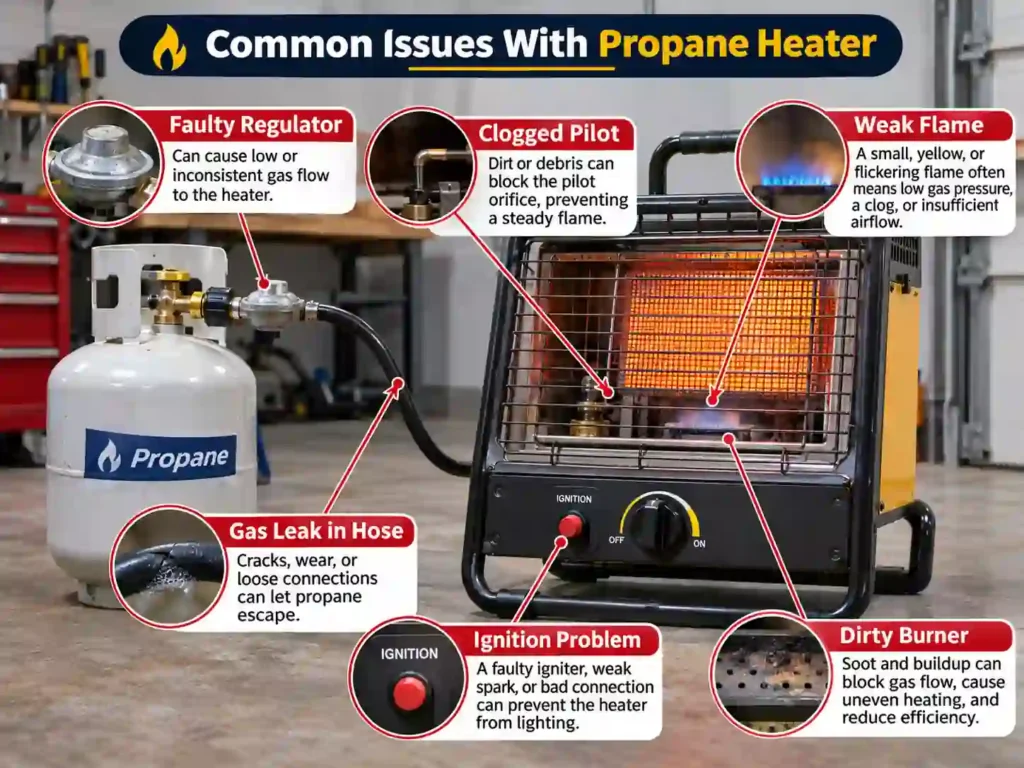
Consider replacement or professional evaluation when you notice cracked hoses, severe corrosion, damaged fittings, excessive abrasion, deteriorated seals, or persistent fuel delivery problems.
| Warning Sign | Recommended Action |
|---|---|
| Cracked hose | Discontinue use and replace with an approved assembly. |
| Severe regulator corrosion | Professional evaluation. |
| Damaged connector threads | Arrange replacement. |
| Blistered or heat-damaged hose | Discontinue use. |
| Persistent weak flames | Professional fuel supply diagnosis. |
| Unusual pressure fluctuations | Professional regulator testing. |
| Gas odor | Evacuate and seek emergency assistance. |
| Persistent icing | Investigate fuel delivery problems. |
You can find additional information in my guide on how to know if a propane heater regulator is failing.
Propane Heater Regulator and Hose Buying Checklist
Before placing your order, use the following checklist to help identify the correct replacement equipment.
Regulator and Hose Purchasing Checklist
Completing this checklist does not replace manufacturer approval or professional installation verification.
Which Regulator and Hose Should You Buy? Decision Guide
Determine whether you have a portable radiant heater, outdoor patio heater, residential wall heater, garage heater, or construction heater.
Check whether the manufacturer requires an external regulator and hose assembly or a specific hose connected to an integrated regulator.
Verify the manufacturer’s specified inlet pressure, maximum fuel input, and approved regulator capacity.
Confirm the approved hose length, pressure rating, connection types, and fuel filter requirements.
Select the original manufacturer-approved replacement part whenever possible. Arrange professional installation when required.
Safety Tips When Installing a New Regulator and Hose
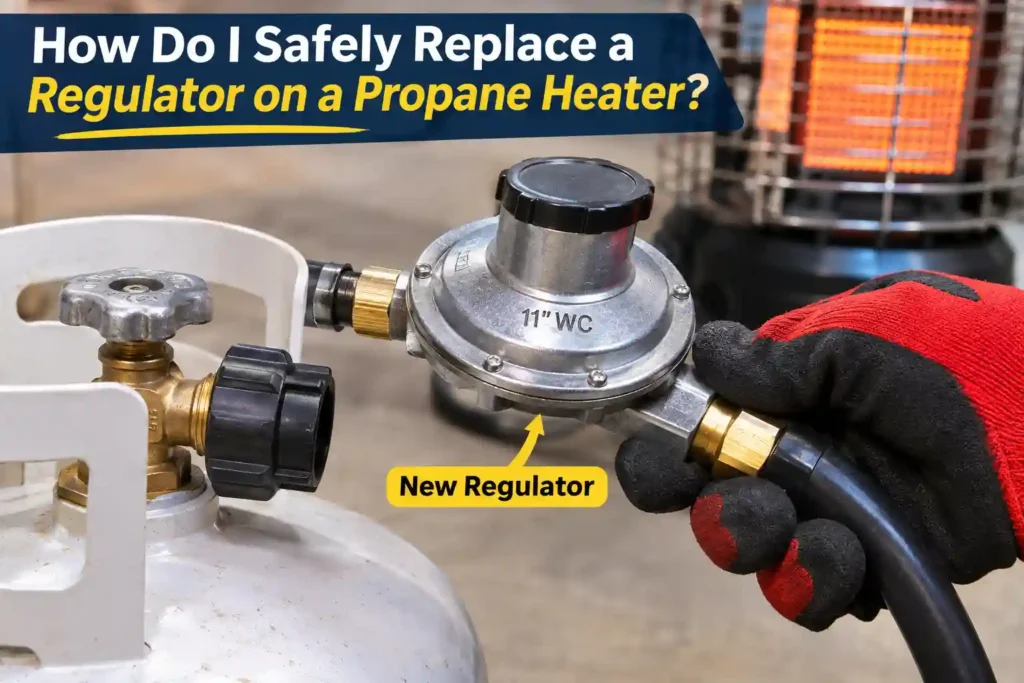
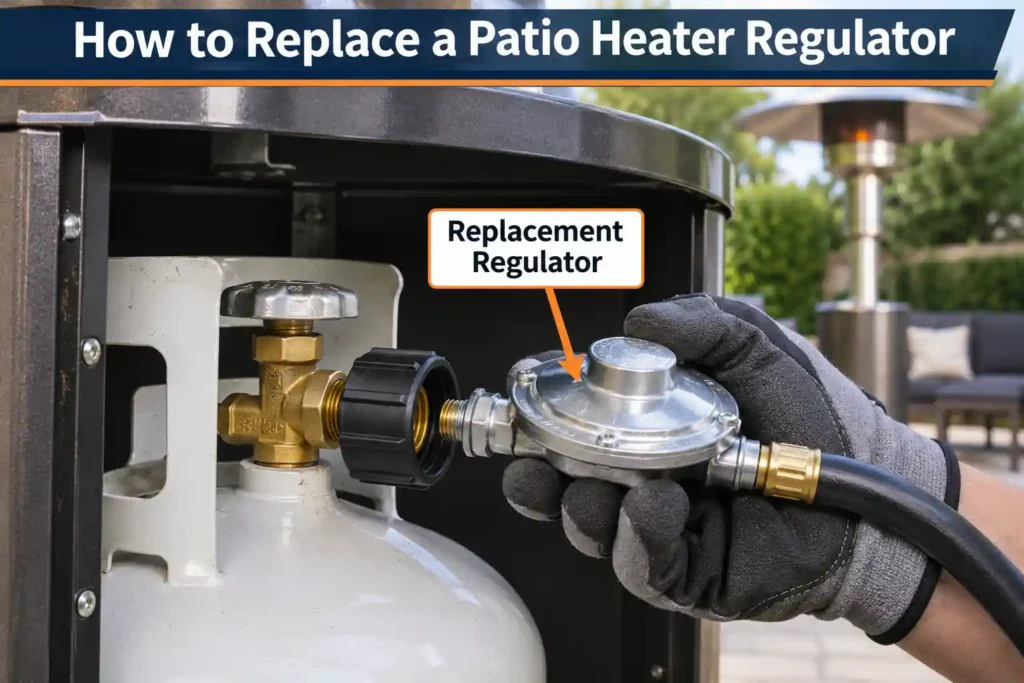
Only replace detachable assemblies yourself when the heater manufacturer expressly permits owner replacement.
Fixed gas piping, integrated regulators, and internal gas-control components should be serviced by qualified professionals.
Never bypass safety devices, modify regulator springs, or use unapproved adapters.
Keep hoses away from hot surfaces, sharp edges, and areas where they may become pinched or damaged. Complete all manufacturer-required leak checks before using the heater.
Important Propane Safety Precautions
- Never use an open flame to test a gas connection.
- Never increase gas pressure beyond the manufacturer’s specifications.
- Do not use damaged or deteriorated propane hoses.
- Avoid unapproved hose extensions and adapters.
- Do not obstruct regulator vents.
- Keep hoses away from hot surfaces and sharp edges.
- Never operate an outdoor-only propane heater indoors.
- Arrange professional inspection when required.
If you suspect a propane leak: Leave the affected area immediately. Avoid flames, electrical switches, and other ignition sources. Contact your propane supplier or emergency services from a safe location.
If a carbon monoxide alarm sounds: Move everyone to fresh air immediately and contact emergency services.
Frequently Asked Questions
Are All Propane Heater Regulators and Hoses Universal?
No. Regulators and hoses differ in operating pressure, capacity, connection types, materials, and manufacturer approval.
Can I Use a BBQ Grill Regulator and Hose on a Propane Heater?
Only when the heater manufacturer approves that particular assembly and all pressure, capacity, and connection requirements are satisfied.
What Is the Best Hose Length for a Propane Heater?
The best hose length is the length specified or approved by the heater manufacturer. Longer hoses are not automatically better.
Can I Connect Two Propane Hoses Together?
Do not extend a propane hose using additional hoses or fittings unless the manufacturer explicitly approves that configuration.
Does a Larger Propane Hose Improve Heater Performance?
A larger hose may reduce flow resistance in certain professionally designed systems. However, it will not correct incompatible gas pressure, inadequate tank vaporization, or a defective regulator.
Do I Need a Regulator With a 20 lb Propane Tank?
Your propane heater requires appropriate pressure regulation, whether supplied by an external regulator or an approved integrated regulator configuration.
Can I Replace a Propane Hose Without Replacing the Regulator?
Yes, if the manufacturer provides an approved separate hose and permits that replacement. Some assemblies are designed to be replaced as a complete unit.
Is a Stainless Steel Braided Propane Hose Better?
It may offer additional abrasion protection, but its actual suitability depends on its internal construction, working pressure, fittings, and manufacturer approval.
Can a Wrong Regulator Damage My Propane Heater?
Yes. Excessive pressure can damage gas-control components and contribute to overheating, improper combustion, and propane leakage.
How Long Does a Propane Heater Hose Last?
Service life depends on hose construction, environmental exposure, frequency of use, and manufacturer recommendations. Replace damaged or deteriorated assemblies promptly.
For regulator longevity, read my guide on how long propane regulators last.
My Final Thoughts
Choosing the right propane heater regulator and hose requires understanding more than the physical size of the components.
Operating pressure, BTU capacity, hose working pressure, connection compatibility, hose length, and manufacturer approval are all essential considerations.
For most consumers, I recommend purchasing the original manufacturer-approved regulator and hose assembly instead of attempting to combine unrelated components.
If your heater has an integrated regulator, make sure you understand its approved fuel delivery configuration before adding an external regulator.
For permanently installed wall heaters, garage heaters, and residential propane systems, professional sizing and installation are particularly important.
A correctly selected regulator and hose assembly can help maintain consistent heating performance, reliable propane delivery, and safe appliance operation for years to come.

Mike is an experienced propane technician with over 15 years of professional experience in the field. He has dedicated his career to helping customers with their propane needs, from installation to maintenance and repair. Together with Jeremy, he co-founded this website to provide useful information and guidance to customers seeking reliable propane services.