When a fire pit starts smelling strange, I recommend answering one question before looking at burner performance or fuel cost: Does this smell suggest unburned gas? If it might, safety comes first. If it is clearly a first-use coating smell or an outdoor contaminant after the appliance has been checked, there is a different set of explanations. In this guide, I’ll show you the difference, explain common causes, compare propane fire pit types, and calculate how much propane a fire pit consumes without confusing normal fuel use with a gas leak.
Propane Fire Pit Odor: Quick-Reference Diagnosis
| Odor or symptom | Possible explanation | My recommendation |
|---|---|---|
| Rotten eggs, skunk, sulfur-like smell | Odorized propane may be escaping | Stop, leave, and report a suspected leak. Do not relight. |
| Gas smell when the unit is OFF | Valve, hose, connection, or supply problem | Follow emergency gas-leak procedures; arrange qualified inspection. |
| Gas smell during or after ignition | Potential failed ignition, delayed ignition, or other gas release | Do not repeatedly attempt ignition; stop and have it checked. |
| New paint, hot metal, or oily smell on first uses | Possible manufacturing residue burning off | Only consider normal if the manufacturer’s manual specifically describes it and no gas leak is suspected. |
| Smoky, burnt-leaf, or food smell | Debris, insects, spills, nearby smoke, or unsuitable media | Turn off and cool fully; inspect and clean following the manual. |
| Soot, persistent smoke, strange flame pattern | Potential burner/media or combustion problem | Stop using; check manual and seek qualified service. |
| Headache, dizziness, nausea near the fire pit | Possible combustion-fume exposure or another medical issue | Move to fresh air immediately and seek urgent medical help if symptoms persist or are significant. |
These clues are not a substitute for leak testing or a professional diagnosis. Strong winds can also carry odors away; the absence of a smell is not a safety certificate.
What Does Propane Smell Like, and Why?
Propane itself has very little natural odor. Suppliers add an odorant, commonly a mercaptan, so people have a better chance of detecting a release. Many describe the added smell as rotten eggs, cabbage, or skunk spray. Different people perceive it differently, and an odor can be masked by smoke, wind, illness, or other smells.
I would never judge a fire pit’s safety by asking whether the flame looks impressive or whether a guest can smell something. Propane vapor is heavier than air, which means escaped gas can settle in depressions, drainage areas, and other low spaces instead of instantly blowing away. That is why a patio with good airflow is not a license to ignore a leak.
There is also a phenomenon called odor fade: under certain conditions the added odorant can weaken, and some individuals cannot reliably smell it at all. A lack of rotten-egg odor does not establish that a connection, burner, or cylinder is safe. The only meaningful response to a suspected leak is proper emergency action and a qualified system check.
What to Do Immediately If Your Propane Fire Pit Smells Like Gas
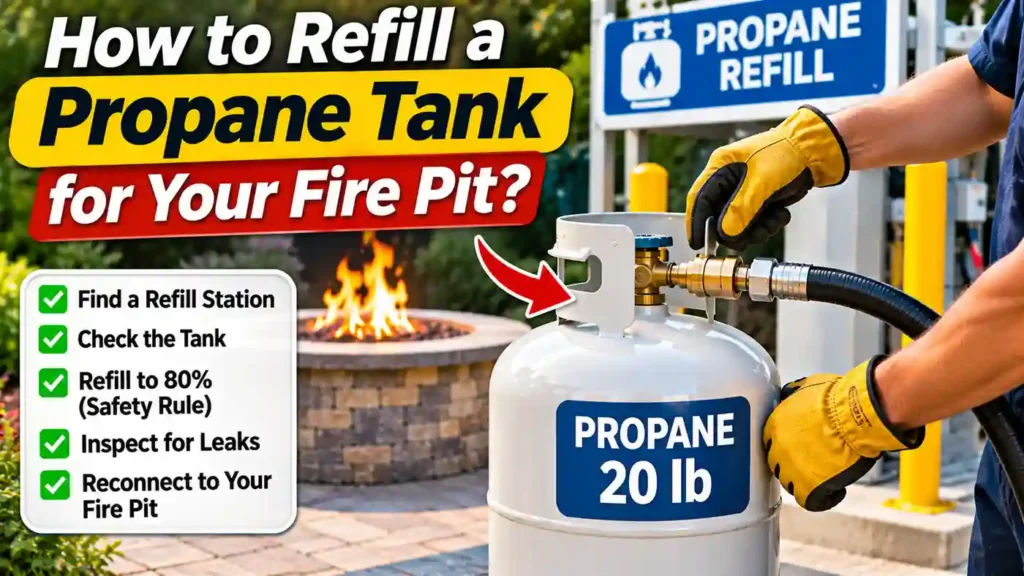
- Stop ignition sources. Do not strike a match, use a lighter, smoke, restart the burner, or operate electrical equipment near the suspected release.
- Get everyone away from the area. Move people and pets away immediately, including away from low spots where leaked propane could collect.
- Close the cylinder valve only if it is safe to do so. Do not approach a cloud of gas, hissing equipment, or a hot or burning cylinder to reach it.
- Call from a safe distance. Contact your propane supplier or local emergency services once you are away from the suspected leak.
- Do not return or reconnect the appliance until the propane supplier, emergency responder, or qualified technician confirms that it is safe.
I do not recommend trying a soap-bubble test, swapping fittings, or tightening a connection while a leak is suspected. A qualified professional can diagnose and leak-test the system after the immediate hazard is addressed. Read my related guide, Are Propane Fire Pits Safe?, for more safety considerations.
Seven Reasons a Propane Fire Pit Can Produce an Odor
1. Unburned propane escaping at a connection
A damaged hose, deteriorated seal, loose fitting, faulty valve, or defective regulator can release gas. A strong odor is an obvious warning, but even a faint suspected gas odor deserves the same serious response. I would not assume a new cylinder eliminates the possibility of a problem: both the appliance and the fuel supply need inspection. Do not try to track a leak with your nose.


2. Failed ignition or a burner that goes out unexpectedly
If gas flows without a stable flame, unburned fuel may escape. Wind, a faulty ignition system, dirt in a burner, or an equipment failure may contribute. The correct response is not to keep clicking the igniter. Stop and arrange an inspection under the manufacturer’s instructions. I cover recurring flame failures in Why Won’t My Propane Fire Pit Stay Lit?.
3. First-use manufacturing residue
Some manufacturers warn that protective oils, films, adhesives, or finishing residues may produce a noticeable smell during the first operating period. This is different from smelling unburned propane. The break-in duration is model-specific; it is not safe to assume every fire pit needs the same number of hours. For a new unit, look at the exact manual before its first use, and do not run it to “burn off” a smell if you suspect gas leakage.
4. Dust, leaves, insects, or debris
A fire pit stored outdoors may collect organic matter. Once heated, that material can make a smoky, earthy, or singed odor. I like inspecting a cold, disconnected or fully shut-down appliance before the first seasonal use. Remove only debris that the manufacturer permits you to remove and avoid poking burner ports with makeshift tools.
5. Incorrect, dirty, or badly positioned fire media
Fire glass, lava rock, and ceramic logs are not interchangeable across all burners. Using the wrong material, piling it too high, or blocking ignition and air pathways can interfere with combustion. Decorative materials must be approved for the specific fire pit. See my guide to decorative elements for propane fire pits before changing media.
6. Soot or abnormal combustion
A yellow decorative flame is not automatically proof of a defect; many fire pit burners are designed for yellow flames. What matters is the flame pattern specified by your particular manual, along with symptoms such as unexpected soot buildup, persistent smoke, flame instability, or an unusual smell. If the flame is abnormal, stop and have the unit checked rather than adjusting fuel pressure or drilling a burner orifice yourself.

7. Odors from the patio rather than the fire pit
Nearby grills, wood-burning fires, lawn chemicals, spilled drinks, melting plastic, and windblown smoke can be mistaken for fire pit emissions. I still use the conservative rule: where the source is uncertain and gas is plausible, treat it as a suspected gas leak. Only consider benign explanations after that possibility is professionally ruled out.
Technical Comparison: How Different Propane Fire Pits Operate
The following heat-output ranges are illustrative product categories, not universal manufacturer specifications. An actual model’s rating plate and manual determine its permitted fuel pressure, hose, regulator, fire media, and outdoor clearance. The 11-inch water-column figure shown below is a common regulated low-pressure propane configuration, not a setting you should apply to every appliance.
| Fire pit type | Illustrative output | Typical fuel supply | Primary odor-related inspection concern |
|---|---|---|---|
| Compact tabletop | 10,000–20,000 BTU/hr | Manufacturer-approved small cylinder or hose system | Ignition, nearby combustible materials, correct cartridge |
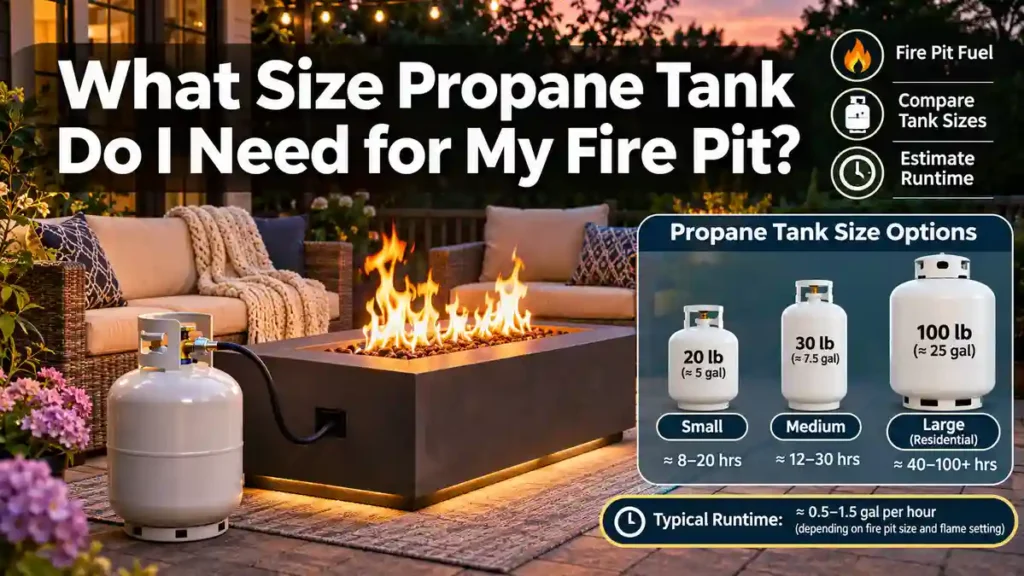
| Portable camping bowl | 30,000–60,000 BTU/hr | 20-lb cylinder with matched hose and regulator | Hose abrasion, transport wear, burner debris |
| Patio fire table | 35,000–55,000 BTU/hr | 20-lb cylinder in approved enclosure or external supply | Enclosure airflow and hidden connections |
| Large decorative burner | 60,000–100,000 BTU/hr | Approved larger supply or designed gas line | Media placement, burner sizing, qualified installation |
| Built-in outdoor fire feature | 75,000–150,000+ BTU/hr | Professionally designed propane installation | Gas train, ventilation, drainage, pressure verification |
Another technical distinction I make is between fuel consumption and escaping fuel. A 60,000-BTU/hr burner naturally consumes more propane than a 20,000-BTU/hr burner when both operate at full rating. That difference does not justify any gas odor outside the normal combustion process. If pressure is in question, read How to Check if Your Propane Fire Pit Has the Right Gas Pressure and use a qualified technician rather than making arbitrary adjustments.
BTU Consumption Chart: How Much Propane Does a Fire Pit Use?
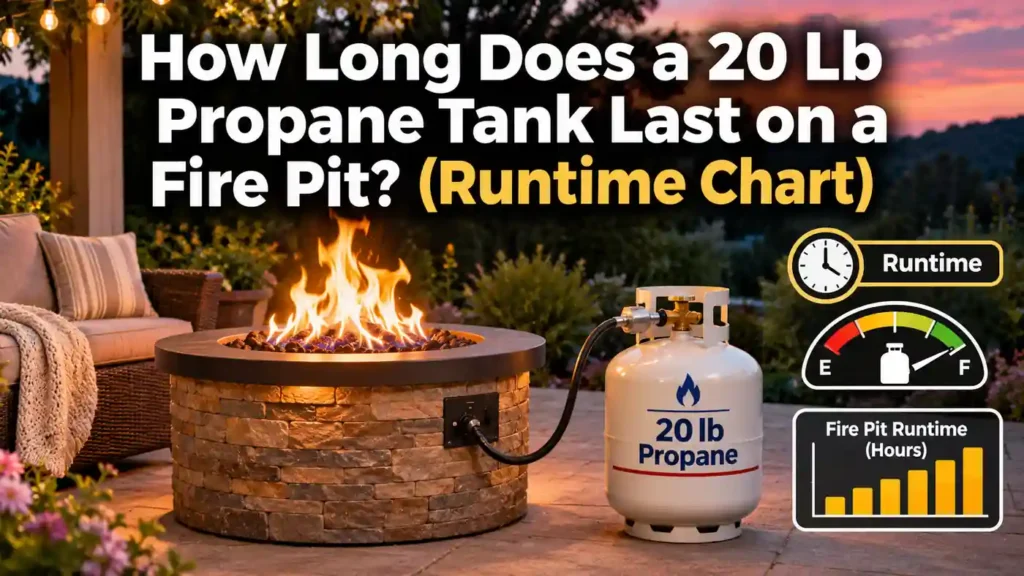
For my calculations, I use 91,500 BTU per US gallon of propane and a nominal 20-lb cylinder holding about 4.7 gallons when properly filled. A burner rated at 50,000 BTU/hr running at its full rated output consumes approximately 50,000 ÷ 91,500 = 0.55 gallon per hour. These are planning estimates, not measured consumption or guarantees of runtime.


| Burner setting/output | Gallons per hour | Approx. pounds per hour | 20-lb tank theoretical runtime |
|---|---|---|---|
| 10,000 BTU/hr | 0.109 | 0.46 | 43.0 hr |
| 20,000 BTU/hr | 0.219 | 0.93 | 21.5 hr |
| 30,000 BTU/hr | 0.328 | 1.39 | 14.3 hr |
| 40,000 BTU/hr | 0.437 | 1.85 | 10.8 hr |
| 50,000 BTU/hr | 0.546 | 2.32 | 8.6 hr |
| 60,000 BTU/hr | 0.656 | 2.78 | 7.2 hr |
| 80,000 BTU/hr | 0.874 | 3.71 | 5.4 hr |
| 100,000 BTU/hr | 1.093 | 4.64 | 4.3 hr |
Calculation assumptions: 4.7 gallons available, 91,500 BTU/gal, and 4.24 lb/gal for mass conversion. Results rounded. Real-world runtime varies with actual fill, burner setting, ambient temperature, cylinder vaporization capacity, and shutdown behavior.
Here is the part I emphasize: a shorter runtime is not a leak detector. High heat demand, a partially filled exchange cylinder, and temperature changes can all affect your experience. If you smell gas, do not compare runtime logs or perform a trial burn; follow the leak procedure first. For ordinary planning after an appliance is known to be safe, see my 20-lb propane tank runtime chart.
Worked Example: A 50,000-BTU Fire Table Used Every Weekend
Let’s say your fire table has a 50,000-BTU/hr nameplate rating and you use it at approximately 70% of rated input for two hours on Friday and three hours on Saturday. For estimation, I treat fuel demand as proportional to that setting; the physical control dial may not be linear, so this is only a model.
- Estimated running input: 50,000 × 0.70 = 35,000 BTU/hr.
- Fuel per hour: 35,000 ÷ 91,500 = 0.383 gal/hr.
- Fuel per five-hour weekend: 0.383 × 5 = 1.91 gallons.
- At $4.00 per gallon: 1.91 × $4.00 = $7.65 per weekend.
- Theoretical 20-lb cylinder runtime: 4.7 ÷ 0.383 = 12.3 hours.
That number helps you budget. It does not tell you whether a hose is sound. If a propane odor appears, even when your total usage looks ordinary, stop using the appliance. I separate those two questions because trying to explain a smell as “just using a lot of fuel” is an unsafe shortcut.
Fuel Cost Scenarios for Common Burner Sizes
The prices below—$3, $4, and $5 per gallon—are illustrative US refill price scenarios, not a claim about today’s rates at a particular retailer. Exchange tanks can cost more per usable gallon, and some exchange cylinders contain less than 20 lb of propane.
| Rated output | Fuel per hour | At $3/gal | At $4/gal | At $5/gal |
|---|---|---|---|---|
| 20,000 BTU/hr | 0.219 gal | $0.66/hr | $0.87/hr | $1.09/hr |
| 30,000 BTU/hr | 0.328 gal | $0.98/hr | $1.31/hr | $1.64/hr |
| 40,000 BTU/hr | 0.437 gal | $1.31/hr | $1.75/hr | $2.19/hr |
| 50,000 BTU/hr | 0.546 gal | $1.64/hr | $2.19/hr | $2.73/hr |
| 60,000 BTU/hr | 0.656 gal | $1.97/hr | $2.62/hr | $3.28/hr |
| 80,000 BTU/hr | 0.874 gal | $2.62/hr | $3.50/hr | $4.37/hr |
If you use a 40,000-BTU/hr unit at full output for 12 hours a month, the estimate is 40,000 ÷ 91,500 × 12 = 5.25 gallons/month. At $4 per gallon, that’s around $20.98/month. For more scenarios, see How Much Does It Cost to Run a Propane Fire Pit?.
Interactive Propane Fire Pit Runtime and Cost Calculator
Use this calculator to estimate your planned fuel usage after you’ve confirmed your fire pit is safe. It is not a gas leak detection tool. Type your appliance’s rated BTU/hr, the estimated proportion of full heat you use, your available fuel, and your local price. The calculation updates as you change an input.
Assumes a constant BTU input proportional to selected firing rate and 91,500 BTU per gallon. Actual control settings and fuel delivery are not perfectly linear. A cylinder may not deliver the full estimated runtime in cold conditions or at high draw.
My Odor Decision Guide: Stop, Inspect, or Keep Using?
| Your situation | Decision | Next action |
|---|---|---|
| Any suspected gas odor, hissing, or escaping propane | Emergency stop | Leave area; close valve only if safe; report from safe location; wait for clearance. |
| Appliance repeatedly fails to light or flame goes out | Stop using | Do not retry ignition; request qualified service. |
| New appliance, faint coating smell, no suspected gas odor, manual expressly expects break-in | Follow manual cautiously | Use only as instructed outdoors; stop if symptoms or unusual conditions develop. |
| Cold fire pit visibly contains leaves or food residue; no gas concern | Clean before use | Follow approved cleaning and media-placement instructions. |
| Unit develops soot, persistent smoke, or unexpected flame pattern | Stop using | Inspect against manual and seek professional service. |
| Cannot identify odor source | Assume possible gas hazard | Stop and seek help; never use a test flame. |
Can a Propane Fire Pit Smell During Startup or Shutdown?
A burner can have a defined ignition and shutdown sequence described in its manual. However, I would not label a noticeable gas odor as an acceptable “startup smell” without a model-specific explanation from the manufacturer and a verified safe system. A failed ignition can release unburned gas, and a flame that goes out while gas continues flowing is dangerous. If you notice a propane odor during or after ignition, stop and follow suspected-leak precautions.
Some people say they smell propane for a second when turning a control knob. That anecdote is not a reliable rule, because duration and strength of odor cannot reliably establish a safe gas concentration. My approach is conservative: never normalize a gas smell merely because it happens briefly. For shutdown planning, see Can You Leave a Propane Fire Pit Burning All Night?.
Is a Smell More Common with a Fire Table Than a Portable Fire Pit?
Neither form factor should leak gas. The difference is where equipment is arranged and what can be overlooked. A portable fire bowl typically has a visible hose extending to its cylinder; a fire table may hide the cylinder and connections inside an enclosure. Concealed components are not inherently unsafe when installed to design, but enclosure ventilation, accessible shutoff controls, and correct cylinder positioning matter.
I recommend treating a new or unusual odor in either design identically: stop, move away, and have any suspected gas problem evaluated. If you’re choosing equipment, my fire pit vs. fire table comparison helps explain differences without implying one can safely tolerate leaks.
How I Would Prevent Odor-Related Problems Before a Gathering
I prefer a maintenance routine that takes place well before guests arrive. A fire pit should never become a last-minute troubleshooting project with an audience standing nearby.
- Read the manual and rating plate. Verify approved fuel, connector, regulator, fire media, operating location, and required clearances.
- Check the cold unit visually. Look for damaged hoses, corrosion, blocked openings, animal nesting material, displaced media, and signs of heat damage. Do not attempt repairs or adjustments beyond the manual.
- Inspect the site. Keep the unit outdoors where its manual permits, away from prohibited overhead covers and low points where gas can collect.
- Use approved professional service when needed. Have an uncertain gas connection, unusual flame, or suspected pressure problem inspected before operation.
- Keep emergency procedures accessible. Everyone using the fire pit should know where the shutoff is and where to move if a gas odor occurs.
- Stay present while it operates. Never leave the flame unattended or assume a safety shutoff makes overnight operation acceptable.
For a seasonal checklist, I wrote Propane Fire Pit Maintenance: What Do I Need to Know?. For an outdoor installation checklist, visit How to Set Up a Propane Fire Pit in Your Backyard.
What About Carbon Monoxide—Does It Smell Like Propane?
No. Carbon monoxide (CO) is odorless, so you cannot detect it by smell. It can be produced by incomplete combustion, and symptoms such as headache, dizziness, weakness, or nausea deserve immediate attention. Get to fresh air and seek emergency medical assistance for suspected exposure. Outdoor-rated propane fire pits belong outdoors; a patio enclosure that feels “almost outside” may still create dangerous ventilation conditions.
Even a clean-looking blue or yellow flame cannot prove the air is free of harmful combustion products. I would not bring an outdoor fire table into a room, garage, tent, or other enclosed space for warmth. I explain the distinction in Can You Use a Propane Fire Pit Table Indoors?.
Frequently Asked Questions About Propane Fire Pit Odor
Should my propane fire pit smell like rotten eggs?
No persistent rotten-egg or skunk-like gas smell should be accepted as normal. Treat it as a possible propane leak, stop use, move away, and contact your supplier or emergency services from a safe place.
Is a slight propane smell normal when I first turn it on?
Do not assume so. Odor strength and duration cannot reliably tell you whether the system is safe. If you suspect unburned propane, stop and follow suspected-leak procedures rather than attempting repeated ignition.
Why does my new propane fire pit smell like burning paint?
Some manufacturers describe initial burn-off of coatings or manufacturing materials. Check your model’s manual. If the smell resembles added propane odorant, you cannot identify the source, or the appliance behaves abnormally, stop using it.
Can fire glass cause a strange smell?
Approved, properly installed fire glass generally should not give off a continuing strong odor. Contaminants, debris, incompatible material, or blocked burner pathways can cause problems. Let the unit cool completely and follow the manufacturer’s cleaning directions.
Can a propane tank leak without any smell?
Yes. Odor fade and human limitations mean a gas leak may not be noticed by smell. Never rely on the absence of odor to verify equipment safety.
How do I know whether my propane fire pit is burning too much gas?
Compare the appliance’s rated BTU/hr and observed fuel usage after the equipment has been checked and is operating safely. The consumption table and calculator can help with budgeting, but they cannot certify that a system is leak-free.
Is it safe to keep using the pit if the smell disappears?
Not if a propane leak was suspected. Odor may dissipate or fade even when a fault remains. Have the system examined and cleared before use.
Can I use a flame to find a propane leak?
Never. An open flame can ignite escaped propane. A suspected leak requires emergency precautions and inspection by qualified personnel, not a homeowner’s ignition experiment.
My Final Take: Treat the Smell as a Safety Question First
The practical distinction is between a manufacturer-described, temporary first-use material odor and any possibility of escaping propane. A new appliance may have a brief break-in smell, and outdoor debris can create smoke. But unburned-gas odor is never something I recommend “waiting out” while the fire pit stays lit. Stop, move away, and get qualified help. When the unit has been confirmed safe, then you can use the BTU and fuel-cost tables above to plan a comfortable evening.
If you’re considering another model instead of repairing an unsafe or aging unit, my Propane Fire Pit Buying Guide: Prices, Types & Features explains your next options.

Mike is an experienced propane technician with over 15 years of professional experience in the field. He has dedicated his career to helping customers with their propane needs, from installation to maintenance and repair. Together with Jeremy, he co-founded this website to provide useful information and guidance to customers seeking reliable propane services.